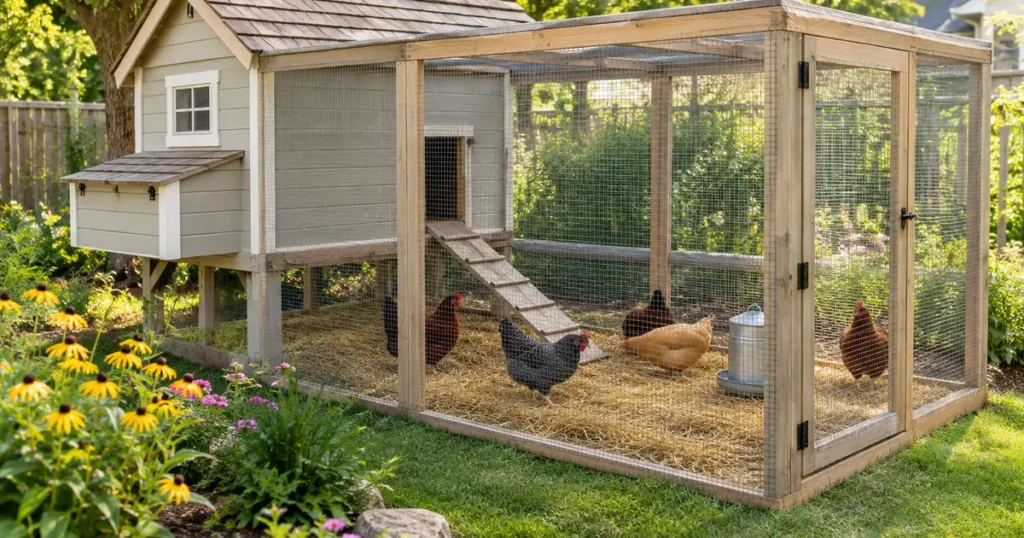
A backyard chicken coop should give each standard-size hen about 4 sq ft of indoor floor space, plus 8 to 10 sq ft per hen in an outdoor run. Add 8 to 10 inches of roost bar per bird and one nesting box for every 4 to 5 hens. That means a flock of 6 needs a coop of roughly 24 sq ft (4 x 6 ft) and a run of about 50 to 60 sq ft.
Quick answer
- Coop: 4 sq ft per standard hen, 2 sq ft per bantam. Go bigger if your hens are shut in for long winters.
- Run: 8 to 10 sq ft per hen. No run at all? Give 8 to 10 sq ft per hen inside the coop.
- Roosts: 8 to 10 inches of bar per bird, about 18 to 24 inches off the floor, higher than the nest boxes.
- Nesting boxes: 1 per 4 to 5 hens (minimum 2), about 12 x 12 x 12 inches.
- Store-bought coop labels often overstate capacity. Measure the floor and divide by 4.
In this guide
- How much space do chickens need?
- Chicken coop size chart by number of hens
- How big should a chicken coop be? Factors that change the answer
- Why “fits 6-8 chickens” store coops are often too small
- How many nesting boxes per chicken?
- Chicken roosting bar: length, height and spacing
- Coop ventilation: the part most coops get wrong
- Common mistakes to avoid
- FAQ
How much space do chickens need?
Extension recommendations vary a bit depending on how much time hens spend outdoors. Oregon State University Extension suggests at least 3 sq ft per bird indoors when hens have a run, and 8 to 10 sq ft per bird when they have no outdoor access. University of Minnesota Extension gives 3 to 5 sq ft of indoor space per bird, and UNH Extension sets 3 sq ft as a minimum for mature laying hens.
Most experienced backyard keepers settle on 4 sq ft per standard hen inside the coop. That extra margin over the minimum gives room for feeders, waterers and the inevitable bad-weather days when the flock stays in. Crowded hens are more likely to peck each other, fight over food and stop laying, and droppings and moisture build up faster.
Space for bantams and large breeds
Bantams are about a quarter to a third the size of standard chickens. Penn State Extension lists 1 sq ft indoors and 4 sq ft of run per bantam as minimums; 2 sq ft indoors is a comfortable backyard target. At the other end, giant breeds like Brahmas, Jersey Giants and large Orpingtons do better with 5 to 6 sq ft indoors.
How much run space do chickens need?
Plan on 8 to 10 sq ft of run per hen. Penn State Extension gives 8 sq ft of outdoor space for laying hens and 10 sq ft for large chickens, and PetMD recommends 8 to 10 sq ft per hen. More is always better: a bigger run means less bare dirt, less mud, fewer squabbles and happier birds. If your hens free-range part of the day, the run can be on the smaller side; if they live in the run full-time, aim for the top of the range or beyond.
Gear that helps
- Walk-in chicken run: A walk-in run adds the 8 to 10 sq ft per hen of outdoor space small coops lack.
As an Amazon Associate we earn from qualifying purchases. Check current prices and reviews on Amazon.
Chicken coop size chart by number of hens
Use this chart to plan your coop, run, roosts and nest boxes. It uses 4 sq ft per standard hen indoors (2 for bantams), 8 to 10 sq ft of run, 8 to 10 inches of roost per bird and one nesting box per 4 to 5 hens with a minimum of two.
| Hens | Coop floor (standard) | Coop floor (bantams) | Run | Roost length | Nesting boxes |
|---|---|---|---|---|---|
| 3 | 12 sq ft (3 x 4 ft) | 6 sq ft | 24-30 sq ft | 24-30 in (2-2.5 ft) | 2 |
| 4 | 16 sq ft (4 x 4 ft) | 8 sq ft | 32-40 sq ft | 32-40 in (about 3 ft) | 2 |
| 6 | 24 sq ft (4 x 6 ft) | 12 sq ft | 48-60 sq ft | 48-60 in (4-5 ft) | 2 |
| 8 | 32 sq ft (4 x 8 ft) | 16 sq ft | 64-80 sq ft | 64-80 in (5.5-6.5 ft) | 2 |
| 10 | 40 sq ft (5 x 8 ft) | 20 sq ft | 80-100 sq ft | 80-100 in (6.5-8.5 ft) | 2-3 |
| 12 | 48 sq ft (6 x 8 ft) | 24 sq ft | 96-120 sq ft | 96-120 in (8-10 ft) | 3 |
| 15 | 60 sq ft (6 x 10 ft) | 30 sq ft | 120-150 sq ft | 120-150 in (10-12.5 ft) | 3-4 |
| 20 | 80 sq ft (8 x 10 ft) | 40 sq ft | 160-200 sq ft | 160-200 in (13.5-16.5 ft) | 4-5 |
Roost length can be split across two or more bars. A 4 x 6 ft coop, for example, can hold two 4-ft roosts, which gives 8 ft of perch for 6 hens with room to spare. Not sure how many hens you need yet? Work it out first with our guide to how many chickens you should get.
How big should a chicken coop be? Factors that change the answer
Your winters
In northern states, hens may spend days or weeks inside when snow piles up or temperatures plunge. Cooped-up birds need more room, so many cold-climate keepers plan for 5 to 6 sq ft per hen or add a covered, wind-blocked run they can use all winter. A coop with more floor space also holds more bedding for the deep litter method.
Free-range or confined
Hens that free-range most of the day only use the coop to sleep, lay and shelter, so the 4 sq ft standard is plenty. If your birds live in a coop with no run at all, Oregon State Extension recommends 8 to 10 sq ft per bird inside.
Breed and temperament
Active, flighty breeds like Leghorns and Cream Legbars need more room than calm heavy breeds. If you mix breeds or sizes, extra space helps lower-ranking hens escape bullies. Our guide to the best egg-laying chickens notes which breeds handle confinement well.
Room to grow
Almost every keeper adds birds over time. Building one size up from your starting flock is cheaper than replacing a coop two years later. It also gives you space to separate a broody, injured or new hen inside the coop with a simple wire divider instead of buying a second shelter.
Why “fits 6-8 chickens” store coops are often too small
This is one of the classic coop hacks every beginner should know: the capacity printed on many prefab coop boxes is optimistic. Some kits list a number of chickens that only works for bantams, or count the space inside the nest box, under the ramp or in the attached mini-run. A coop advertised for “6 to 8 chickens” may have an interior floor closer to 10 or 12 sq ft, which by the 4 sq ft standard comfortably fits about 3 standard hens.
Before you buy, check three numbers on the product listing:
- Interior floor area. Measure or calculate only the enclosed sleeping area, not the run or the nest box. Divide by 4 for standard hens.
- Roost length. Add up the inches of roost bar and divide by 8 to 10. That is the real number of birds that can sleep comfortably.
- Run area. Divide the attached run’s square footage by 8 to 10.
The lowest of the three numbers is your true capacity. Many small kits also use thin wood and light hardware that raccoons can defeat, so plan on reinforcing them with tips from our predator-proof chicken coop guide.
Coop hack: If you love a small prefab coop, pair it with a separate walk-in run. The coop handles sleeping and laying for 3 or 4 hens, while a roomy walk-in run gives them daytime space and makes cleaning and egg collecting much easier on your back.
Gear that helps
- Chicken coop kit sized for 6 hens: Readers who want a prefab coop should choose one with at least 24 sq ft of real interior floor.
As an Amazon Associate we earn from qualifying purchases. Check current prices and reviews on Amazon.
How many nesting boxes per chicken?
Provide one nesting box for every 4 to 5 hens, with at least two boxes in any coop. University of Minnesota and University of Maryland Extension both recommend one box per 4 to 5 birds, and University of Kentucky Extension advises a minimum of two per flock. Penn State Extension suggests two nests for the first four hens, then one more for each additional four.
You do not need one box per hen. Hens take turns, and they often all want the same favorite box anyway. Too many boxes can backfire, because extra boxes tend to become sleeping spots that fill with droppings.
Nesting box size
A standard nesting box is about 12 inches wide, 12 inches deep and 12 inches tall, the size recommended by Oregon State and University of Kentucky Extension. Large breeds like Brahmas, Jersey Giants and big Orpingtons appreciate 14 x 14 inches. Bantams are happy with 10 x 10 inches.
Where to put nesting boxes
- Mount boxes off the floor, in a darker, quieter corner of the coop.
- Keep them lower than the roost bars, so hens do not choose the box as a bed.
- Add a 3 to 4 inch lip at the front to hold in bedding and keep eggs from rolling out.
- A sloped roof over outside-mounted boxes keeps hens from perching and pooping on top.
- Line boxes with clean straw, pine shavings or a removable nest pad, and refresh bedding whenever it gets soiled so eggs stay clean.
Gear that helps
- Metal or plastic nesting boxes: Ready-made 12 x 12 in boxes are an easy way to get the right number of nests in any coop.
As an Amazon Associate we earn from qualifying purchases. Check current prices and reviews on Amazon.
Chicken roosting bar: length, height and spacing
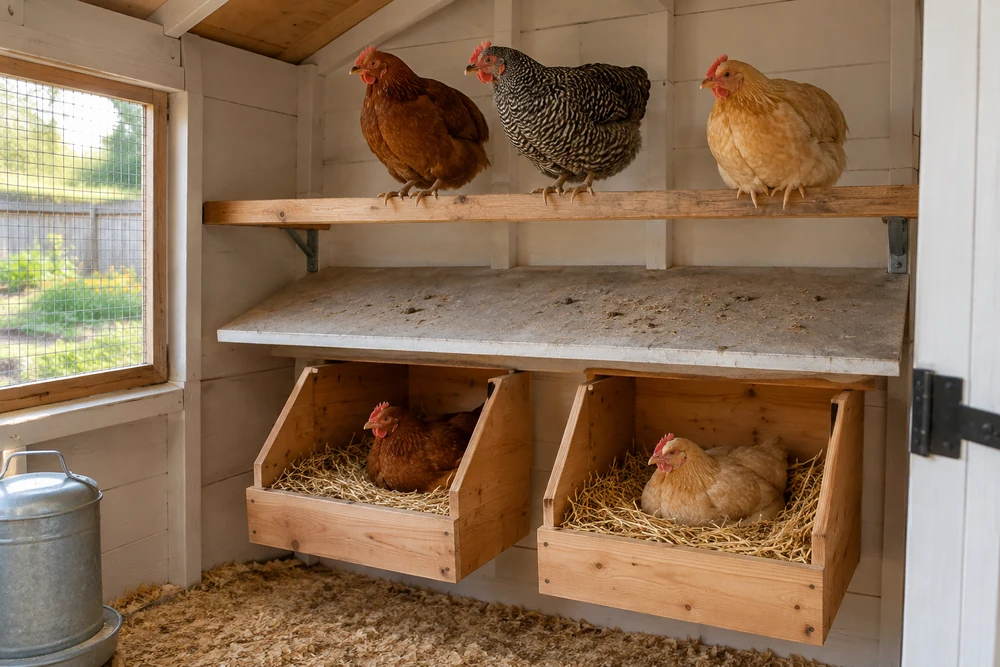
Chickens sleep perched, and a good roost keeps them off the damp floor at night. Recommendations from extension services range from 5 to 12 inches per bird: Penn State lists 6 inches, Oregon State 5 to 10 inches, and UNH Extension up to a foot. For standard backyard hens, 8 to 10 inches per bird is a comfortable target. They huddle tightly in winter and spread out in summer heat, so a little extra helps in hot climates.
| Roost detail | Standard hens | Bantams |
|---|---|---|
| Length per bird | 8-10 in | 4-6 in |
| Height off floor | 18-24 in (up to about 3-4 ft for light breeds) | 12-18 in |
| Space between parallel bars | 10-18 in apart | 10-12 in apart |
| Distance from wall | About 12 in or more | About 10 in |
Best material for a chicken roosting bar
Wood is best because it gives a good grip and stays warmer than metal or plastic. Oregon State Extension suggests 1 to 2 inch square lumber with rounded top edges. Many backyard keepers use a 2×4 laid with the wide side up, so hens can rest flat-footed and cover their toes with their feathers on cold nights. Sturdy, smooth natural branches also work. Avoid slick round dowels and metal pipe.
Roost height and safety
Penn State Extension cautions against roosts higher than about 4 feet, since heavy birds can hurt their feet and legs jumping down. If you set bars at different heights, stagger them like a ladder rather than stacking them directly above each other, so birds on the top bar do not soil those below. A droppings board under the roosts makes daily cleanup quick.
Coop ventilation: the part most coops get wrong
Good airflow matters as much as floor space. Chickens release a lot of moisture through breathing and droppings, and ammonia builds up quickly in a closed coop. Damp, stale air is linked to respiratory problems in summer and frostbite in winter, because moist air freezes on combs and wattles.
- A widely used rule of thumb is about 1 sq ft of vent opening for every 10 sq ft of floor, with more in hot climates.
- Put vents high on the walls or under the roof eaves, above the roost bars, so air moves without blowing directly on sleeping hens.
- Cover every opening with 1/2-inch hardware cloth, not chicken wire, to keep predators out.
- Oregon State Extension notes that passive ventilation (windows and vents) is enough for most backyard coops.
If you smell ammonia when you open the door, the coop needs more ventilation, fresh bedding or both. For cold-weather setup, see how to winterize a chicken coop without sealing it airtight.
Backyard Chickens Mastery
More eggs, healthy hens, zero losses: the step-by-step guide that puts every coop hack in one place, from first flock to fifth winter.
Get the guide ($17)Common mistakes to avoid
- Trusting the box label. Divide the real interior floor by 4 to get standard-hen capacity.
- Forgetting the run. A coop alone is not enough for full-time confinement; plan 8 to 10 sq ft of run per hen.
- Nest boxes higher than roosts. Hens will sleep and poop in them, leading to dirty eggs.
- Too many nesting boxes. One per 4 to 5 hens is enough.
- Sealing the coop for winter. Drafts on birds are bad, but airflow above them is essential.
- Building for today’s flock only. Size up for the hens you will add later.
- Chicken wire on windows and vents. It keeps chickens in but does not keep raccoons out.
FAQ
What size coop do I need for 6 chickens?
For 6 standard hens, plan on a coop of at least 24 sq ft (for example 4 x 6 ft), a run of 48 to 60 sq ft, about 4 to 5 ft of roost bar and 2 nesting boxes.
Is 4 square feet per chicken enough?
Yes, 4 sq ft per standard hen inside the coop is enough when hens also have a run of 8 to 10 sq ft each or free-range time. Without outdoor access, give 8 to 10 sq ft per bird indoors.
How many chickens can fit in a 4×8 coop?
A 4 x 8 ft coop has 32 sq ft of floor, which fits about 8 standard hens or up to 16 bantams, as long as they also have a properly sized run.
Do chickens need a nesting box each?
No. One nesting box for every 4 to 5 hens is enough, with a minimum of two boxes. Hens happily share and often prefer the same box.
How high should a chicken roost be?
Place roosts about 18 to 24 inches off the floor for standard hens and 12 to 18 inches for bantams, always higher than the nesting boxes and no higher than about 4 feet.
What happens if a chicken coop is too small?
Crowded hens are more likely to peck and bully each other, lay fewer eggs and live in a damper, dirtier coop, which raises the risk of illness. If you notice feather pecking or wounds, give more room, add distractions and separate any injured hen until she heals.
Keep reading
Sources
- Living on the Land: Backyard Chicken Coop Design – Oregon State University Extension
- Small Scale Poultry Housing – Penn State Extension
- Raising chickens for eggs – University of Minnesota Extension
- Poultry Housing: Construction-Specific Requirements – University of Maryland Extension
- Producing Your Own Eggs – UNH Cooperative Extension
- Urban Poultry (ASC-241) – University of Kentucky Cooperative Extension
- Backyard Chickens: A Pet Parent’s Guide – PetMD