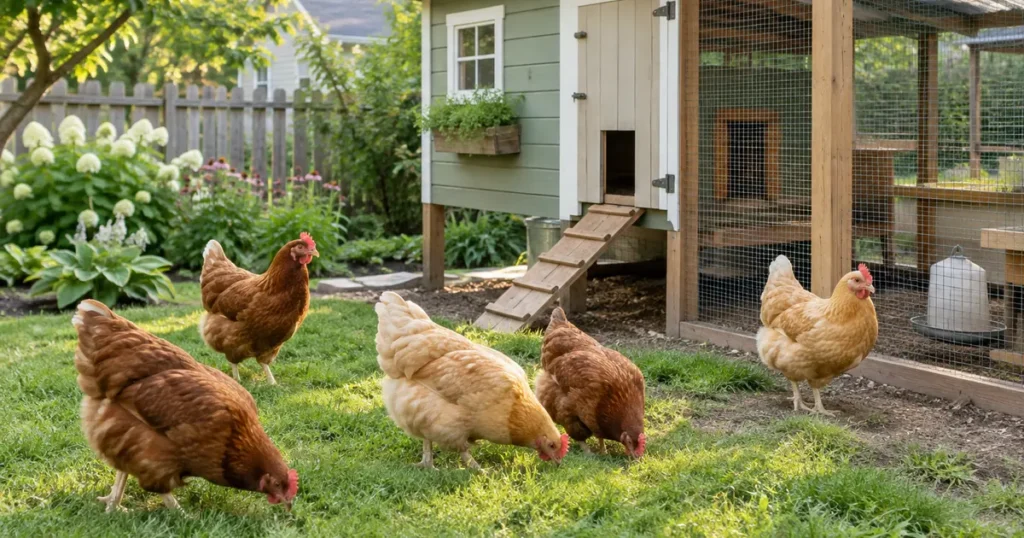
Backyard chickens are one of the easiest livestock projects you can start: a small flock of 4 to 6 hens needs a secure coop, layer feed, clean water and about 15 minutes of care a day. Start by checking your local rules, pick calm egg-laying breeds, and put most of your budget into a predator-proof coop. Do that, and you can expect your first eggs when your hens are around 5 to 6 months old.
Quick answer
- Check city ordinances and HOA rules first: many towns cap hen numbers and ban roosters.
- Plan on at least 2 to 4 sq ft of coop space and 8 to 10 sq ft of run space per standard-size hen.
- Budget roughly $500 to $1,500 to get started and about $30 to $50 a month to feed six hens on conventional feed (prices vary by region).
- Hens lay without a rooster. Most start at 18 to 24 weeks and lay best in their first two years.
- Biosecurity matters: bird flu (HPAI) is still active in the US as of October 2026, so keep wild birds away and report sudden deaths.
In this guide
- Is it worth raising chickens?
- Step 1: Check local laws, zoning and HOA rules
- Step 2: Choose the right breeds for beginners
- Step 3: Chicks, pullets or adult hens?
- Step 4: Set up a safe chicken coop and run
- Step 5: Feed and water your flock
- Step 6: Your daily, weekly and seasonal routine
- Cost of raising chickens: a realistic budget
- Step 7: Health and biosecurity basics
- Step 8: Protect your chickens from predators
- Step 9: Eggs: what to expect
- Common mistakes to avoid
- FAQ
Is it worth raising chickens?
It depends on what you want from them. If your only goal is cheap eggs, backyard chickens rarely win in year one. Once you add the coop, feeder, waterer and chicks, your first dozens can easily cost more than store eggs.
The math improves after the startup costs are paid off. From the second or third year, many keepers produce eggs for about the same price as premium grocery-store eggs, with fresher yolks and full control over what the hens eat. You also get free compost material, bug and weed control, and a daily routine that kids love.
Chickens are worth it if you:
- Can commit to daily care, 365 days a year, including holidays and blizzards.
- Have a neighbor, friend or sitter who can cover when you travel.
- Accept that hens slow down in winter and during molt, and that they live 8 years or more while laying well for only 2 to 3.
- Are ready to invest in predator protection before the birds arrive.
Step 1: Check local laws, zoning and HOA rules
Before you buy a single chick, find out what is allowed where you live. Chicken rules are set locally, so they change from one town to the next.
- City or county ordinance: search “[your city] chicken ordinance” or call the zoning office. Look for the maximum number of hens, permit fees, and coop setbacks from property lines and neighbors’ homes.
- Roosters: many suburban towns allow hens but ban roosters because of noise.
- HOA covenants: a homeowners association can prohibit poultry even where the city allows it. Read your CC&Rs.
- Slaughter and egg sales: if you plan to sell eggs, your state may have labeling and storage rules.
Some cities require an inspection before you get a permit. A quick call now avoids having to rehome a flock later.
Step 2: Choose the right breeds for beginners
For a first flock, pick breeds known for being calm, cold-hardy (or heat-tolerant, depending on your climate) and reliable layers. Production varies a lot: Penn State Extension notes that commercial-type hybrids can lay 240 to 280 eggs a year, while many heritage breeds lay far fewer.
| Breed | Eggs per year (approx.) | Temperament | Good for |
|---|---|---|---|
| ISA Brown / Red Star (sex-link) | 250-300 | Friendly, busy | Maximum eggs |
| Rhode Island Red | 200-280 | Hardy, can be bossy | Cold and heat |
| Buff Orpington | 180-200 | Very gentle | Families, kids |
| Barred Plymouth Rock | 200-280 | Calm, curious | Cold winters |
| Australorp | 250+ | Docile | All-around layer |
| Easter Egger | 200-250 | Friendly | Blue or green eggs |
Egg counts are typical ranges, not promises: nutrition, daylight and age all change the result. For a full comparison, see our guide to the best egg-laying chickens for beginners.
How many chickens should you get?
Chickens are flock animals and get stressed alone, so start with at least three. A good rule of thumb: two to three hens per egg-eating person in your household. A family of four that eats eggs most days often lands at six hens. Our article on how many chickens to get walks through the math.
Step 3: Chicks, pullets or adult hens?
You can start at three different ages. Each has trade-offs in cost, effort and how soon you get eggs.
| Option | Typical price per bird | Pros | Cons |
|---|---|---|---|
| Day-old chicks | $4-$8 | Cheapest, widest breed choice, very tame birds | Need a brooder and heat for about 6 weeks; no eggs for 5-6 months |
| Started pullets (16-20 weeks) | $25-$50 | No brooder, eggs within weeks | Fewer breeds available, higher price |
| Adult laying hens | Varies widely | Eggs right away | Unknown health history, may be past peak laying |
Whatever you choose, buy from a source that participates in the National Poultry Improvement Plan (NPIP). Order “sexed pullets” rather than “straight run” if roosters are not allowed: a straight-run chick has roughly a 50% chance of being male. Ask the hatchery whether chicks are vaccinated against Marek’s disease, which has to be done right after hatch.
Brooder basics for chicks
Chicks need a warm, draft-free brooder with sides 12 to 18 inches high. Alabama Cooperative Extension recommends starting at 95°F (35°C) at chick level, about 2 inches above the bedding, and lowering the temperature by 5°F each week. Watch the chicks: huddled under the heat means too cold, crowding the edges means too hot.
Warning: Heat lamps cause brooder and coop fires every year. If you use one, clamp it with a chain or secure bracket, never by its cord, and keep it well away from bedding. Radiant heat plates are a safer choice for most home brooders.
Gear that helps
- Chick brooder heating plate: Safer than a heat lamp for raising day-old chicks
As an Amazon Associate we earn from qualifying purchases. Check current prices and reviews on Amazon.
Step 4: Set up a safe chicken coop and run
The coop is where most of your money should go, because a weak coop is how most beginners lose birds. Extension recommendations vary slightly, but these numbers are a safe starting point for standard-size hens:
- Coop floor: 2 to 4 sq ft per bird (University of Minnesota Extension suggests 3 to 5 sq ft if birds spend a lot of time inside).
- Run: 8 to 10 sq ft per bird, more if you can.
- Roosts: about 6 to 8 inches of bar per bird, 18 to 24 inches off the floor.
- Nesting boxes: about 12 x 12 inches, one box per 4 to 5 hens.
- Ventilation: vents high on the walls, above the roost, so moisture and ammonia escape without a draft on sleeping birds.
Our chicken coop size guide has a calculator-style table for 3 to 20 hens.
Coop hack: Buy or build a coop one size bigger than you need today. “Chicken math” is real: most keepers add birds in year two, and extra space prevents pecking and boredom in winter.
Gear that helps
- 1/2 inch galvanized hardware cloth roll: Predator-proofing the coop and run is the top beginner priority
As an Amazon Associate we earn from qualifying purchases. Check current prices and reviews on Amazon.
Step 5: Feed and water your flock
Feeding chickens is simpler than it sounds, because complete commercial rations are balanced for each life stage.
| Age | Feed | Notes |
|---|---|---|
| 0-6 weeks | Chick starter | Medicated or non-medicated; ask your feed store which fits your chicks |
| 6-18 weeks | Grower or starter-grower | Lower calcium than layer feed |
| 18 weeks or first egg | Layer feed (usually about 16% protein) | Offer crushed oyster shell on the side for strong shells |
A standard hen eats roughly a quarter pound of feed a day, so a 50-lb bag lasts six hens about a month. Treats and kitchen scraps should stay under about 10% of the diet, or egg production and health suffer. Check our chart of what chickens can and can’t eat before tossing leftovers into the run.
Water matters even more than feed. A laying hen can stop laying after a day without water. Provide clean water at all times, and plan ahead for winter: our guide to heated chicken waterers shows how to keep it from freezing.
Gear that helps
- Hanging chicken feeder and waterer set: Keeps feed and water clean and reduces waste
As an Amazon Associate we earn from qualifying purchases. Check current prices and reviews on Amazon.
Step 6: Your daily, weekly and seasonal routine
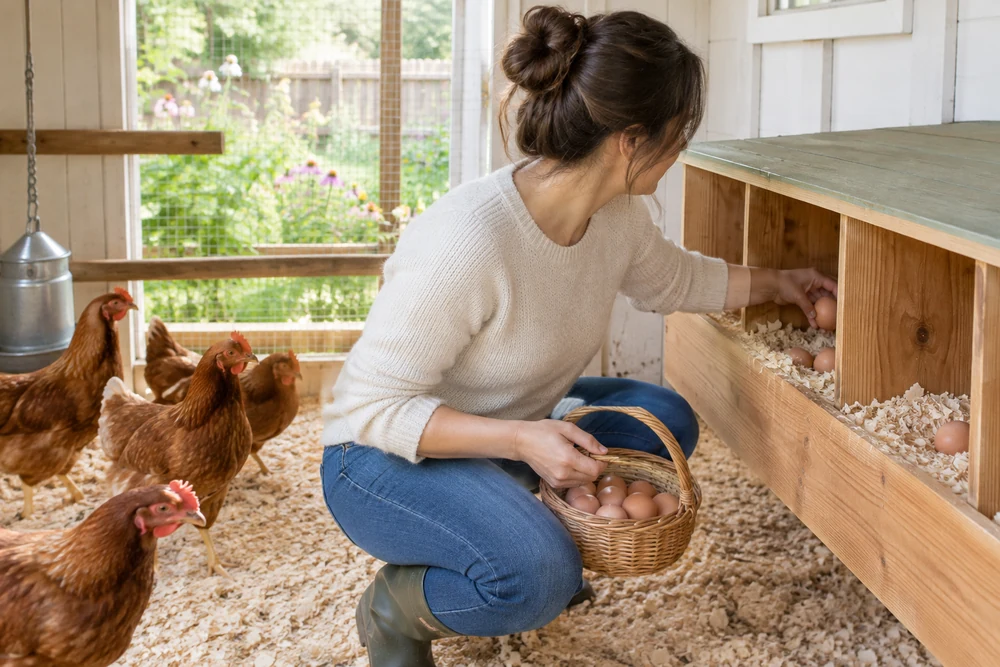
Most daily chores take less than 15 minutes. Here is a realistic care schedule:
| When | Task |
|---|---|
| Every morning | Open the coop (or check the automatic door), refill feed and fresh water, look at every bird for 30 seconds |
| Every afternoon | Collect eggs (twice a day in hot or freezing weather) |
| Every evening | Count birds, close and latch the coop at dusk |
| Weekly | Scoop the droppings board, add fresh bedding, scrub waterers, check for mites at night |
| Monthly | Walk the coop and run for gaps, loose wire or digging; check feet and vents |
| Spring | Deep clean, order new chicks, watch for broody hens |
| Summer | Shade, extra waterers, good airflow for heat |
| Fall | Expect molting and a laying slowdown; winterize the coop |
| Winter | Prevent frozen water, keep ventilation open, no unsafe heat sources |
Fall is the season that surprises new keepers. Hens lose feathers and stop laying during molt; see chicken molting explained and do chickens lay eggs in winter. For cold-weather prep, read how to keep chickens warm in winter and how to winterize a chicken coop.
Cost of raising chickens: a realistic budget
The table below assumes six hens bought as day-old chicks, conventional (non-organic) layer feed, and a mid-range prefab or DIY coop. Feed prices vary a lot by region and change often, so treat these as ballpark ranges as of fall 2026.
| Item | Startup cost | Monthly cost |
|---|---|---|
| 6 chicks ($4-$8 each) or 6 pullets ($25-$50 each) | $24-$300 | – |
| Brooder, heat plate, chick feeder and waterer | $60-$150 | – |
| Coop and run (DIY to prefab) | $300-$1,000+ | – |
| Hardware cloth, latches, automatic door | $100-$300 | – |
| Adult feeder and waterer | $40-$100 | – |
| Layer feed (about one 50-lb bag) | – | $18-$30 (organic: $35-$55) |
| Bedding (pine shavings or straw) | – | $5-$15 |
| Oyster shell, grit, treats | – | $3-$10 |
| Total (approx.) | $525-$1,850 | $30-$55 |
Not included: vet visits, which can cost more than the bird itself, and electricity for a heated waterer in cold states. Set aside a small emergency fund so a sick hen never turns into a money panic.
Backyard Chickens Mastery
More eggs, healthy hens, zero losses: the step-by-step guide that puts every coop hack in one place, from first flock to fifth winter.
Get the guide ($17)Step 7: Health and biosecurity basics
Most backyard flock problems start with crowding, wet bedding or a new bird that brings in disease. Simple habits prevent most of it.
- Quarantine new birds for 30 days away from your flock, as recommended by USDA’s Defend the Flock program.
- Use dedicated coop shoes or boot covers, and wash hands before and after chores.
- Keep wild birds out: cover feeders and waterers, and fix spilled feed that draws sparrows and ducks.
- Keep bedding dry: damp litter breeds coccidia and ammonia.
- Look at your birds daily: a hen standing hunched with her tail down, not eating, is telling you something.
Bird flu (HPAI) as of October 2026
Highly pathogenic avian influenza is still circulating in wild birds and poultry in the US, and risk usually climbs with fall and spring migration. According to the Merck Veterinary Manual, more than half of the flocks affected since 2022 have been backyard flocks. Warning signs include sudden deaths, swollen heads, purple combs and wattles, breathing trouble and a sharp drop in eggs. If you see them, call your state veterinarian or USDA at 1-866-536-7593. Don’t move birds or carcasses before you get instructions.
Chickens can also carry Salmonella without looking sick. The CDC recommends washing hands after handling birds or eggs, and not kissing or snuggling poultry. For a full symptom checklist, see signs of a sick chicken and what to do.
Step 8: Protect your chickens from predators
Raccoons, foxes, hawks, dogs and weasels will find your flock, even in town. Build security in from day one:
- Use 1/2-inch hardware cloth, not chicken wire, on runs, vents and windows.
- Add a buried wire apron or skirt at least 12 inches around the run to stop digging.
- Use two-step latches that raccoons can’t open.
- Cover the run against hawks and owls.
- Close the coop every night, or use an automatic door on a light sensor or timer.
Our full guide to building a predator-proof chicken coop covers each predator and the signs it leaves.
Gear that helps
- Automatic chicken coop door: Closes the coop at dusk even if you are late
As an Amazon Associate we earn from qualifying purchases. Check current prices and reviews on Amazon.
Step 9: Eggs: what to expect
Most hens start laying between 18 and 24 weeks, depending on breed and season. Pullets that reach laying age in fall may wait until late winter or spring, because egg production depends on day length: hens lay best with about 14 to 16 hours of light.
Do you need a rooster to get eggs?
No. Hens lay eggs with or without a rooster. You only need a rooster if you want fertile eggs to hatch chicks. Many towns ban roosters anyway, and an all-hen flock is quieter and calmer.
Collecting and storing eggs
Collect eggs at least once a day to keep them clean and discourage egg eating. If eggs are dirty, gently dry-brush them; if you wash them, use water warmer than the egg and refrigerate them afterward. Penn State Extension recommends storing eggs at 45°F (7°C) or below. If your hens stop laying, our guide to why chickens stop laying eggs walks through the 11 most common causes.
Coop hack: Put a ceramic or wooden “dummy” egg (or a golf ball) in each nesting box when your pullets near laying age. It shows them where to lay and cuts down on eggs hidden in the run.
Common mistakes to avoid
- Buying chicks before checking ordinances, HOA rules and your coop budget.
- Using chicken wire to keep predators out: it keeps chickens in, but raccoons can tear through it.
- Feeding layer feed to young chicks, or skipping layer feed for laying hens.
- Too many treats and scraps, which lowers protein and egg production.
- Sealing the coop airtight in winter: poor ventilation causes frostbite and respiratory problems.
- Leaving a heat lamp hanging by its cord over dry bedding.
- Adding new birds without a 30-day quarantine.
- Waiting too long to find a poultry vet. Look for one before you need one.
FAQ
How much space do backyard chickens need?
Plan on at least 2 to 4 sq ft per standard hen inside the coop and 8 to 10 sq ft per hen in the run. Bantams need about half that. More space means less pecking and cleaner bedding.
How long do chickens live?
Backyard hens often live 8 years or more, and some reach 10 to 12. Most lay well for their first two to three years, then lay fewer eggs each year.
Can you raise chickens in a small backyard?
Yes, if your town allows it. Three to four hens fit in a small coop with a covered run of about 30 to 40 sq ft. Keep the coop clean and dry so odor and flies don’t bother neighbors.
Do backyard chickens smell?
A clean, dry, well-ventilated coop smells mostly of wood shavings. Strong ammonia odor means wet bedding or poor airflow, and it is bad for the birds’ lungs too.
Can chickens free-range all day?
They can, but free-ranging raises the risk of predators and contact with wild birds that carry avian flu. Supervised free-range time or a large covered run is safer for most beginners.
When do chickens start laying eggs?
Most hens start between 18 and 24 weeks old. Breed, nutrition and day length all affect timing, so fall-hatched pullets may not lay until spring.
Keep reading
Sources
- Successfully Raising a Small Flock of Laying Chickens – Penn State Extension
- Small Scale Poultry Housing – Penn State Extension
- Raising Chickens for Eggs – University of Minnesota Extension
- Brooding Tips for Successful Bird Performance – Alabama Cooperative Extension System
- Want to Raise Backyard Chickens for Eggs? 5 Things to Know First – Colorado State University
- Defend the Flock: Biosecurity Every Day, Every Time – USDA APHIS
- Common Infectious Diseases in Backyard Poultry – Merck Veterinary Manual
- Salmonella Outbreak Linked to Backyard Poultry – CDC