
The egg float test tells you roughly how old an egg is, not whether it is safe to eat. Lower an egg into a bowl of water: a very fresh egg sinks and lies flat, an older egg tips up or stands on its point, and a very old egg floats. That happens because the air pocket inside the egg grows as it ages. Treat the result as a freshness clue, then crack the egg into a separate bowl and let your nose and eyes make the final call.
Quick answer
- Sinks and lies flat: very fresh. Tilts or stands on end: older but usually fine. Floats: old, with a large air cell.
- The test measures the air cell, which grows with age. It says nothing about Salmonella or other bacteria.
- USDA notes that a floating egg is poor quality but may still be safe; a sinking egg can still be contaminated.
- Only float eggs you will use right away. Wet shells and cold water can draw bacteria through the shell, so never float eggs you plan to store unwashed on the counter.
- The best habit: pencil the lay date on every egg, then crack each egg into a separate bowl and sniff before using it.
In this guide
- How to do the egg float test (step by step)
- Why do old eggs float? The air cell explained
- Egg float test chart: sink, tilt, stand or float
- What the float test can’t tell you
- Better ways to check if an egg is still good
- How to date your own eggs (so you rarely need the float test)
- Does the float test work on store-bought eggs?
- Common mistakes to avoid
- FAQ
How to do the egg float test (step by step)
- Fill a clear bowl or tall glass with clean water deep enough to cover the egg by about 2 inches (5 cm). Use water that is not colder than the egg; room-temperature tap water is fine for eggs from the fridge.
- Lower the egg gently with a spoon so it does not crack on the bottom.
- Wait a few seconds until it settles, then look at its position from the side.
- Read the result with the chart below.
- Lift it out right away, dry it well with a paper towel and use it the same day, or refrigerate it and use it within a day or two.
Test one egg at a time, keep it in the water for seconds rather than minutes, and never leave a batch of eggs soaking in a bowl.
Why do old eggs float? The air cell explained
An egg is laid warm, close to the hen’s body temperature. As it cools, the contents shrink and a small pocket of air forms at the large end, between the two thin membranes just inside the shell. That pocket is the air cell.
The shell is covered in thousands of tiny pores. Day after day, moisture and gases slowly escape through them and air takes their place, so the air cell gets bigger and the egg gets lighter for its size. Once the air cell is big enough, the egg tilts, then stands up, then floats.
Storage speeds this up or slows it down. Alabama Extension notes that a day at room temperature ages an egg about as much as a week in the refrigerator. Humidity and shell thickness also change the rate, which is why two eggs laid on the same day can float differently a month later.
USDA egg graders measure the same thing with a light instead of water. A Grade AA egg has an air cell 1/8 inch deep or less; Grade B starts once it passes 3/16 inch. The float test is a rough, kitchen version of that check.
Egg float test chart: sink, tilt, stand or float
| What the egg does | What it means | Rough age if refrigerated | Best use |
|---|---|---|---|
| Sinks and lies flat on its side | Small air cell, very fresh | About the first week | Anything; best for fried and poached eggs, where a firm white matters |
| Sinks, but the large end tilts up | Air cell growing, still good quality | Roughly 1 to 3 weeks | Everyday cooking and baking |
| Stands on its point on the bottom | Large air cell, older egg | Several weeks | Scrambled, baked or hard-boiled (older eggs peel more easily); crack into a separate bowl first |
| Floats to the surface | Very large air cell, old or stored warm | Many weeks to months | Not automatically bad: crack it into a separate bowl and check; if anything seems off, throw it out |
The ages are only a guide. An egg kept on a warm counter can stand up in a week or two, while a clean egg stored in a cold fridge can still lie almost flat after several weeks.
What the float test can’t tell you
It shows age, not safety
Salmonella does not make an egg lighter. Salmonella Enteritidis can infect the inside of an egg before the shell even forms, and a contaminated egg looks, smells and sinks just like a clean one. No home test can detect it; refrigeration and thorough cooking are what protect you.
A floating egg isn’t automatically rotten
USDA’s Food Safety and Inspection Service says an egg floats once its air cell is large enough to keep it buoyant, and that such an egg is of poor quality but may be perfectly safe. Many keepers still toss floaters for peace of mind, and that is a reasonable choice, but the float alone is not proof of spoilage.
A sinking egg can still be a bad egg
A fresh egg that was cracked, laid in a dirty nest or left in a hot coop for a day can sink perfectly and still carry bacteria. Check every egg for hairline cracks and heavy soiling, whatever it does in the water.
The water itself can pull bacteria in
USDA warns that wash water can be drawn into an egg through the shell pores, and CDC advises against putting warm, fresh eggs into colder water for the same reason: the contents contract and pull liquid, along with any bacteria on the shell, inward. Getting the shell wet also weakens the bloom, the natural coating that seals those pores.
Warning: Do not float-test eggs and then put them back on the counter. Once an egg has been in water, treat it like a washed egg: dry it, refrigerate it and use it soon. Never float-test eggs you plan to keep unwashed at room temperature or to store long term, such as eggs for counter or fridge storage or for preserving.
Better ways to check if an egg is still good
Crack it into a separate bowl and sniff
This is the most reliable kitchen check. Crack each egg into a small bowl before adding it to the pan or batter. A spoiled egg has a strong sulfur smell you will not mistake. Throw out any egg with an off odor, a slimy or powdery shell, or a white or yolk that is pink, green, black or iridescent.
The bowl also shows freshness. A fresh egg has a tall, rounded yolk and a thick white that stays close to it. An older egg has a flatter yolk and a white that spreads thin. Both can be safe; the older one is just better suited to baking or scrambling.
A small blood spot is not a sign of spoilage. It is a tiny broken blood vessel from laying and can be lifted out with the tip of a spoon if you prefer.
Candle it
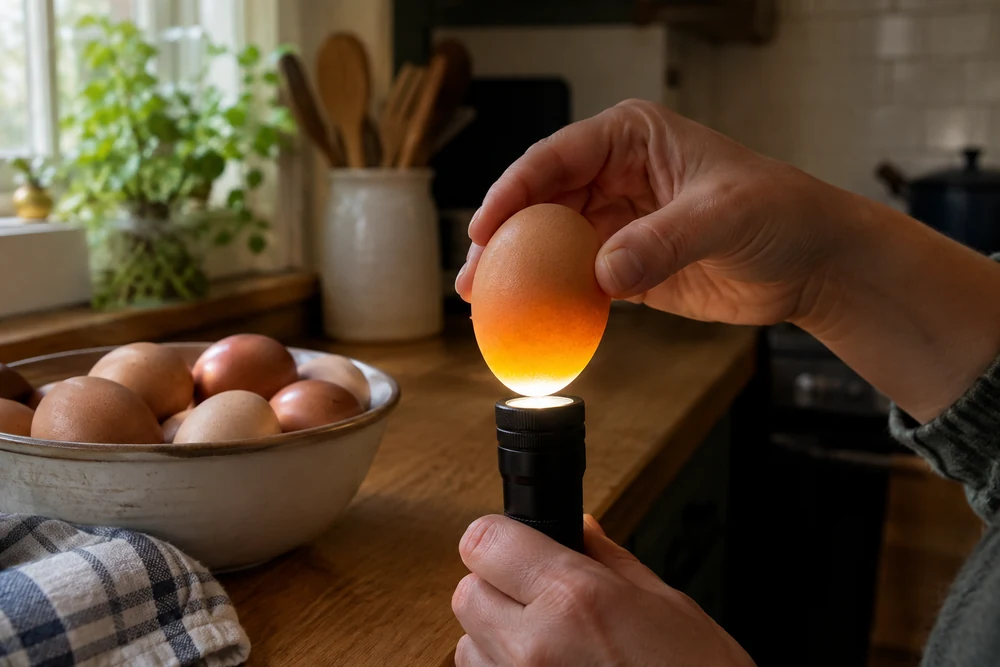
Candling is what egg graders do, and it keeps the shell dry. In a dark room, hold the egg’s large end against a bright flashlight and tilt it slowly. You will see the air cell as a pale cap at the large end: a thin sliver means fresh, a deep pocket means older. Candling also shows hairline cracks and larger blood spots.
Coop hack: Make a free candler from your phone’s flashlight and an empty toilet paper tube. Stand the tube over the light, set the egg on top with the large end down, and check it in a dark room. No water, no wet shells.
Look at the shell
CDC advises throwing away cracked eggs from your flock, because bacteria on the shell can get inside more easily. Discard eggs with cracks, leaks, slime or mold spots. Light dirt can be removed dry with a brush or fine sandpaper.
Gear that helps
- LED egg candler: Shows the air cell, cracks and blood spots without getting the shell wet.
As an Amazon Associate we earn from qualifying purchases. Check current prices and reviews on Amazon.
How to date your own eggs (so you rarely need the float test)
Backyard keepers have an advantage over shoppers: you know the day every egg was laid. Write it down and the guesswork disappears.
Coop hack: Keep a soft pencil in the egg basket and write the date (for example “10/6”) on the large end of each egg as you collect it. Pencil needs no water, does not bleed through and stays readable for weeks. Use the oldest eggs first.
- Label the carton too. Write the week on the lid and keep a “first in, first out” order in the fridge.
- Use a rolling rack. A spiral egg rack feeds new eggs in at the top and the oldest out at the bottom, so rotation happens on its own.
- Collect at least once a day, twice in hot or freezing weather. Eggs that sit in the nest get dirty, cracked or overheated, and you lose track of their age.
- Mark eggs found in a hidden nest. A surprise clutch under a bush could be days or weeks old. Those are the eggs where candling helps most, and when in doubt, throw them out.
If a hidden nest is the reason your egg count dropped, our guide to why chickens stop laying eggs covers how to find it and the other common causes.

The complete guide · 2027 Edition
Backyard Chickens Mastery
Want steadier eggs all year? More eggs, healthy hens, zero losses: every coop hack in one step-by-step guide.
- 188 pages, 9 parts, 70 Coop Hacks
- 20 breed profiles, a 60-food safe chart and a laying troubleshooter
- 9 printable checklists, including the Winter Egg-Laying Checklist
Gear that helps
- Spiral countertop egg rack (egg skelter): Rotates eggs automatically so the oldest are used first.
- Wire egg collecting basket: Keeps a pencil and the day's eggs together for dating at collection.
As an Amazon Associate we earn from qualifying purchases. Check current prices and reviews on Amazon.
Does the float test work on store-bought eggs?
Yes, the physics is the same. Commercial eggs are washed and refrigerated, and USDA advises using them within 3 to 5 weeks of purchase. By the time they reach a store, many are already a week or more old, so it is normal for store eggs to tilt in the water. The same limits apply: the result shows age, not safety.
New to keeping hens and wondering how many eggs you will be dating each week? Start with our beginner’s guide to backyard chickens.
Common mistakes to avoid
- Treating a sinking egg as “safe” and skipping the separate-bowl check.
- Throwing out every egg that tilts. A tilted egg is simply a bit older and usually perfect for baking or hard-boiling.
- Dropping warm, just-collected eggs into cold water.
- Float-testing a whole basket and putting the eggs back on the counter wet or unrefrigerated.
- Leaving eggs soaking in the bowl while you test the rest.
- Using a permanent marker or a wet sponge to label eggs instead of a dry pencil.
- Ignoring hairline cracks because the egg passed the float test.
- Eating eggs from a hidden nest without candling or checking them first.
FAQ
Is it safe to eat eggs that float?
Sometimes. USDA says a floating egg is poor quality but may still be safe. Crack it into a separate bowl: if it smells bad, looks discolored or the shell was cracked, throw it out. When in doubt, discard it.
How accurate is the egg float test?
It is a fair guide to age, because it measures the air cell. It cannot detect Salmonella, cracks or spoilage, and storage temperature and humidity change how fast an egg starts to float.
Do fresh eggs sink or float?
Fresh eggs sink and lie flat on their side because the air cell is still small. As the egg ages, the large end tilts up, then the egg stands on its point, and a very old egg floats.
Why does my egg stand up in water?
Its air cell has grown large enough to lift the wide end. The egg is likely a few weeks old. It is usually fine to use after a sniff check, and it is a good choice for hard-boiling.
Can you put eggs back in the fridge after a float test?
Yes, but dry them first and use them within a day or two. Water can weaken the shell’s protective coating, so tested eggs should not go back on the counter or into long-term storage.
Keep reading
Sources
- Shell Eggs from Farm to Table – USDA Food Safety and Inspection Service
- What You Need to Know About Egg Safety – U.S. Food and Drug Administration
- Backyard Poultry – Centers for Disease Control and Prevention
- No Bad Eggs: Internal Egg Quality – University of Wisconsin-Madison Extension
- Tips for Enhancing Egg Quality and Safety from Washing to Cooking – Alabama Cooperative Extension System
- Market Eggs: Interior Egg Grading by Candling – University of Kentucky, National 4-H Poultry
- How to Safely Handle and Store Eggs from Your Home Flock – Penn State Extension