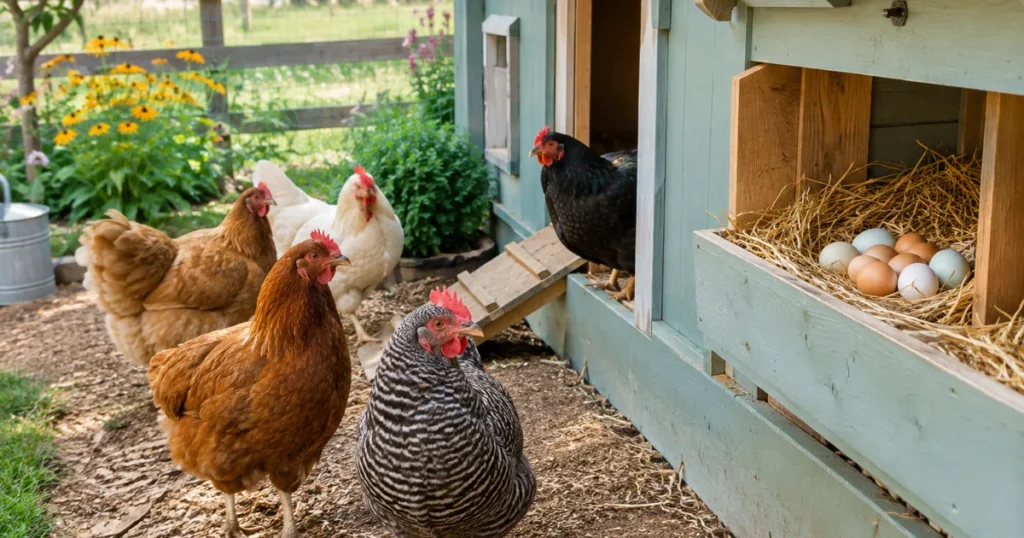
A healthy hen lays at most one egg a day, because it takes about 24 to 26 hours to form each egg. In practice, a good layer gives about 4 to 6 eggs a week in her prime and roughly 150 to 300 eggs a year, depending on breed. Most hens start laying at 18 to 22 weeks old, lay best in their first two years, then taper off gradually rather than stopping on a set date.
Quick answer
- Per day: one egg at most, and not every day. An egg takes about 24 to 26 hours to form.
- Per week: about 5 to 6 eggs for top layers at their peak, 3 to 5 for most heritage breeds, fewer in winter.
- Per year: roughly 250 to 300+ for hybrid layers, 150 to 250 for heritage breeds, 100 to 150 small eggs for many bantams.
- First egg: usually at 18 to 22 weeks of age, later for some heavy and ornamental breeds.
- How long they lay: strong production for 2 to 3 years, then fewer eggs each year. Many hens still lay now and then at 5 or 6.
In this guide
- How many eggs does a chicken lay a day?
- How many eggs does a chicken lay a week?
- How many eggs does a chicken lay a year? (by breed type)
- Egg production by age: year 1 to year 5+
- At what age do chickens start laying eggs?
- Do chickens lay eggs all year? Seasonal changes
- What affects how many eggs a chicken lays
- How long do chickens lay eggs?
- Common mistakes to avoid
- FAQ
How many eggs does a chicken lay a day?
One, at the very most. University of Wisconsin Extension explains that a hen ovulates every 24 to 26 hours, and the yolk then needs about a day in the oviduct to collect its white, membranes and shell. Because the cycle runs a little longer than 24 hours, each egg tends to come a bit later in the day than the last one.
Eventually the timing slides too late in the afternoon, and the hen skips a day before starting a new run. Those runs of eggs on consecutive days are called clutches. A top hybrid might lay many days in a row before a break; a heritage hen takes days off more often. A double-yolked egg is two yolks in one shell, not two eggs, and it is most common in young pullets just starting out.
How many eggs does a chicken lay a week?
A productive hen in her prime lays about 5 or 6 eggs a week in spring and summer. University of Minnesota Extension describes roughly six eggs a week for a good layer during her peak years. Heritage and dual-purpose breeds usually give 3 to 5 a week, and many hens drop to a handful of eggs or none in the shortest weeks of winter.
If you are planning a flock around your family’s weekly egg use, our guide on how many chickens you should get turns these numbers into a simple flock-size table.
Gear that helps
- Countertop egg holder / egg skelter: Keeps the daily collection organized and used oldest first.
As an Amazon Associate we earn from qualifying purchases. Check current prices and reviews on Amazon.
How many eggs does a chicken lay a year? (by breed type)
Breed is the biggest factor you control. Commercial-style hybrids have been bred for decades to lay almost daily; heritage and fancy breeds trade some laying for hardiness, size, looks or broodiness. Oregon State University Extension notes that a commercial White Leghorn lays about 265 eggs a year, and most backyard breeds lay fewer than commercial strains.
| Breed type | Examples | Eggs per year (first laying year, approx.) | Eggs per week at peak | Notes |
|---|---|---|---|---|
| Hybrid / production layers | ISA Brown, Golden Comet, Red Star, production Leghorns | 250-300+ | 5-6 | Rarely go broody; output may fall faster after year 2-3 |
| Productive heritage breeds | Rhode Island Red, Barred Plymouth Rock, Australorp, Sussex | 200-280 | 4-5 | Hardy, good for families, lay a bit longer |
| Dual-purpose and heavy breeds | Buff Orpington, Wyandotte, Brahma, Cochin | 150-220 | 3-4 | Calm, cold-hardy, more likely to go broody |
| Bantams and ornamentals | Silkie, Belgian d’Uccle, Polish, Sebright | 100-150 | 2-3 | Small eggs; Silkies go broody often |
These are typical ranges, not promises. Individual hens vary, and feed, light and stress can move the numbers a lot. For breed-by-breed picks, see our list of the best egg-laying chickens.
Egg production by age: year 1 to year 5+
Hens do not have a sudden “menopause,” but each year brings fewer eggs. Rutgers notes that while some hens lay for up to 10 years, most are economically productive for only about two. University of Wisconsin Extension adds that egg numbers, egg size and shell quality all decline year after year, and recommends adding young pullets every 2 to 3 years. Eggs do get larger with age, even as there are fewer of them.
| Hen’s laying year | Hybrid layer (approx. eggs/year) | Heritage hen (approx. eggs/year) | What to expect |
|---|---|---|---|
| Year 1 (from first egg) | 250-300+ | 180-250 | Peak laying; small pullet eggs at first, then full size |
| Year 2 | 200-250 | 160-220 | Strong laying after the first molt; larger eggs |
| Year 3 | 150-200 | 140-190 | Noticeable slowdown; longer breaks in winter |
| Year 4 | 100-150 | 100-160 | Sporadic laying; more shell issues possible |
| Year 5+ | 0-100 | 50-120 | Occasional eggs, mostly spring and summer |
Treat this table as a rough planning estimate. Many keepers notice that hybrids lay hard early and slow down sooner, while heritage hens lay fewer eggs per year but keep going a little longer. Either way, a hen with good care can live 6 to 8 years or more in a backyard, so plan for several years of retirement.
At what age do chickens start laying eggs?

Most pullets lay their first egg between 18 and 22 weeks of age, according to the University of Arizona, University of Wisconsin and Rutgers extension programs. Oregon State puts typical production pullets at 18 to 20 weeks. Some heavy breeds and bantams take longer, closer to 6 or 7 months.
Season matters too. Pullets that reach laying age in late fall, when days are short, may wait until days lengthen in late winter or spring. Signs that the first egg is near:
- Comb and wattles turn from pale pink to full red and grow larger.
- She squats when you reach toward her back.
- She checks out the nesting boxes and may fuss in them.
- She gets louder, with an “egg song” after laying.
First eggs are often small, oddly shaped or soft-shelled. That usually settles within a few weeks. Switch from grower feed to layer feed (with oyster shell on the side) around 18 weeks or at the first egg.
Coop hack: Put a ceramic or wooden “dummy egg” (a golf ball works too) in each nesting box a couple of weeks before laying age. It shows pullets where eggs belong, so you are not hunting for first eggs under bushes.
Gear that helps
- Ceramic dummy eggs: Teaches pullets where to lay so first eggs are not hidden.
As an Amazon Associate we earn from qualifying purchases. Check current prices and reviews on Amazon.
Do chickens lay eggs all year? Seasonal changes
Laying is driven by day length. Hens need about 14 to 16 hours of light to lay well, and production slows when days drop below about 12 hours, says Rutgers. That is why most backyard flocks lay heavily from spring into summer, slow in fall and may nearly stop in December and January.
Fall also brings the yearly molt, when hens drop old feathers and put their protein into new ones instead of eggs. Molting usually starts between August and October and can stop laying for several weeks to a few months. For more on both, see our guides to winter laying and chicken molting.
What affects how many eggs a chicken lays
- Breed and age: the two biggest factors, covered in the tables above.
- Light: fewer than about 12 hours of daylight slows laying.
- Feed: a complete layer feed with about 16% protein and enough calcium. Too many treats or scratch grains dilute the diet.
- Water: an egg is mostly water. A frozen or empty waterer can stop laying for days.
- Stress: predators, moving, new flock mates, heat waves and rough handling all slow laying.
- Broodiness: a hen who wants to hatch eggs stops laying. See our guide to the broody hen.
- Parasites and illness: mites, lice, worms and disease can all cut production.
If laying stops and you cannot find the reason, our pillar guide on why chickens stop laying eggs walks through every cause.
Warning: A sudden drop in eggs along with lethargy, a hunched posture, not eating, labored breathing, swelling or unusual droppings is not a normal slowdown. Contact an avian vet or your state poultry lab. Several sick or dead birds at once should be reported to your state veterinarian or USDA APHIS, since avian influenza is active in the US as of October 2026.

The complete guide · 2027 Edition
Backyard Chickens Mastery
Want steadier eggs all year? More eggs, healthy hens, zero losses: every coop hack in one step-by-step guide.
- 188 pages, 9 parts, 70 Coop Hacks
- 20 breed profiles, a 60-food safe chart and a laying troubleshooter
- 9 printable checklists, including the Winter Egg-Laying Checklist
Gear that helps
- Nesting box pads: Clean, comfortable nests encourage hens to lay in the box.
As an Amazon Associate we earn from qualifying purchases. Check current prices and reviews on Amazon.
How long do chickens lay eggs?
Most hens lay well for 2 to 3 years, says Oregon State University Extension, while University of Wisconsin Extension notes that most flocks produce eggs for 3 to 4 years. After that, laying becomes occasional and seasonal. There is no fixed end date, and some older hens surprise their owners with spring eggs at 6 or 7.
To keep a steady supply, many keepers add 2 or 3 pullets every couple of years. Older hens still earn their keep by eating bugs, producing compost and keeping the flock calm. If you face end-of-life decisions for an aging or ill hen, talk with a vet about humane options.
Common mistakes to avoid
- Expecting an egg a day from every hen. Even top layers skip days.
- Panicking over the first winter slowdown. Shorter days and molt are normal.
- Switching to layer feed too early. Wait until about 18 weeks or the first egg.
- Picking breeds for looks only. Silkies and Polish are charming but lay far less.
- Too many treats. Keep treats to about 10% of the diet.
- Forgetting age. A 4-year-old hen laying 2 eggs a week is often perfectly healthy.
FAQ
Can a chicken lay 2 eggs in one day?
Very rarely. Occasionally a hen releases two yolks close together, but laying two complete eggs in a day is uncommon and not something to expect. A double-yolked egg is one egg with two yolks.
What time of day do chickens lay eggs?
Most eggs are laid in the morning, within several hours after sunrise. Because each egg takes a bit more than 24 hours, a hen lays slightly later each day until she skips a day.
Do chickens need a rooster to lay eggs?
No. Hens lay eggs without a rooster. A rooster is only needed if you want fertile eggs to hatch.
How many eggs does a chicken lay in its lifetime?
A productive hen might lay roughly 600 to 1,000 eggs over her life, with most of them in the first three years. Heritage and bantam hens lay fewer.
How do I know if my chicken is too old to lay eggs?
Older hens lay less often, mostly in spring and summer, and their combs may stay paler outside the laying season. A healthy hen of 5 or more that lays only occasionally is usually just aging, not sick.
Why are my pullet’s first eggs so small?
First eggs from young pullets are often small, sometimes with no yolk or a soft shell. Egg size increases over the first weeks and keeps growing as the hen matures.
Keep reading
Sources
- Life Cycle of a Laying Hen – University of Wisconsin-Madison Extension
- Raising Chickens for Eggs (PNW 565) – Oregon State University Extension
- Egg Production – Rutgers Cooperative Extension
- Nine Common Reasons Your Hens Aren’t Laying – University of Arizona Cooperative Extension
- Raising chickens for eggs – University of Minnesota Extension
- Laying and Reproduction in Backyard Poultry – Merck Veterinary Manual