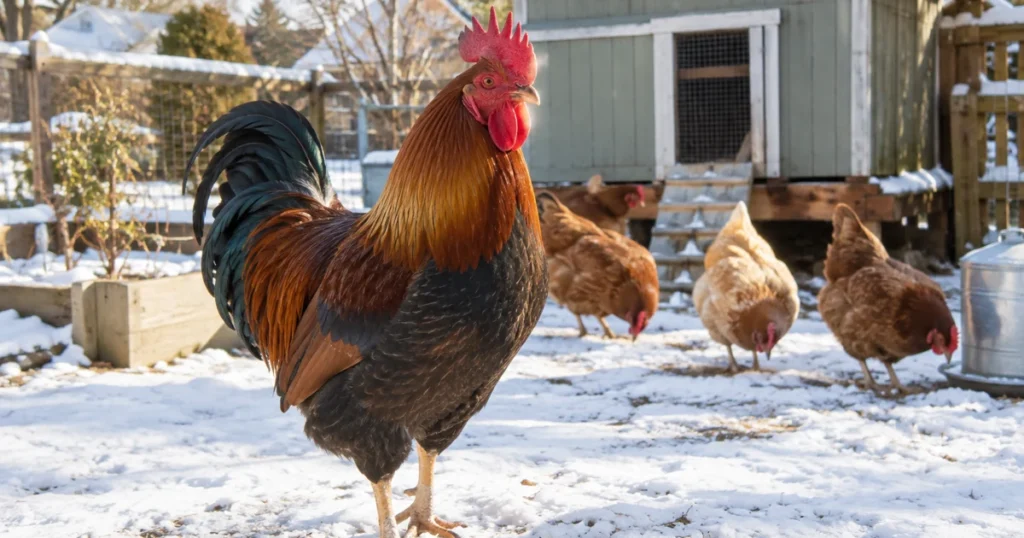
Frostbite on chickens happens when the fluid in exposed tissue freezes, usually on a large comb, the wattles or the toes. It is far easier to prevent than to treat: a dry, well-ventilated coop and the right roosts do most of the work. If it does happen, gentle first aid and patience matter more than any cream, and a vet is the right call for swollen, smelly or badly damaged tissue.
Quick answer
- Moisture causes more frostbite than cold alone: damp coop air on a cold night is the classic setup.
- Early frostbite looks pale or grayish; damaged tissue turns dark or black and brittle over the next days.
- Warm the bird slowly in a sheltered spot. Never rub the tissue, use snow, or thaw it under a heat lamp.
- Leave black tips alone: they protect the tissue underneath and usually fall off in several weeks.
- Call an avian vet if you see swelling, oozing, a bad smell, lameness or a bird that stops eating.
In this guide
- What is frostbite in chickens?
- What causes chicken frostbite?
- How to prevent frostbite in chickens
- Does Vaseline prevent frostbite on chickens?
- How to tell if your chicken has frostbite
- Frostbite chicken comb treatment: first aid basics
- How long does chicken frostbite take to heal?
- A note on bird flu and winter checks
- Common mistakes to avoid
- FAQ
What is frostbite in chickens?
Frostbite is tissue damage caused by freezing. When ice forms in and around cells, the cells die, and the surrounding blood vessels can be damaged too. In chickens, the parts with little or no feather cover and a lot of surface area are the first to go: the comb, the wattles and the toes.
Roosters are the most frequent victims because they carry the biggest combs and wattles. Hens of breeds with tall single combs, such as Leghorns, are next in line. Rose-combed and pea-combed birds rarely lose much tissue, which is one reason breed choice is part of prevention.
What causes chicken frostbite?
Cold sets the stage, but moisture usually decides whether frostbite happens. Chickens breathe out a lot of water vapor, and their droppings are mostly water. In a closed-up coop, that moisture hangs in the air and condenses on the coldest surfaces, including combs and wattles. University of Minnesota Extension names the combination of high moisture and cold as the main cause.
Common triggers include:
- A sealed or under-ventilated coop where humidity builds overnight.
- Wet bedding around the waterer or under the roosts.
- Wind blowing on roosting birds through gaps at roost height.
- Wet combs and wattles after drinking from an open waterer, then going out into freezing wind.
- Standing on snow or ice for long periods, or roosting on thin round dowels where toes are not covered.
- Single-digit and sub-zero nights, especially the first hard cold snap of the season.
How to prevent frostbite in chickens

Prevention is mostly coop management. If you get the air and the roosts right, most flocks get through a northern winter with no damage at all.
Keep the air dry with ventilation
Ventilation is the single biggest lever. Vents should be high on the walls or under the eaves, above the birds’ heads, so warm, damp air can rise and leave without a breeze blowing across the roost. If you see frost or condensation on the inside of walls and windows in the morning, or smell ammonia when you open the door, the coop needs more air exchange, not less. Our coop ventilation guide covers how much vent area to aim for.
Stop drafts at roost height
Airflow above the birds is good; wind on the birds is not. Close gaps and cracks near the roosts and the floor, and keep the pop door shut at night. A quick test: stand at roost height on a windy day. If you feel air on your face, the hens feel it too.
Use wide, flat roosts
A 2×4 laid with the wide side up lets a hen sit down over her feet and cover her toes with belly feathers. Ohio State University Extension recommends giving each bird roosting space off the floor, about 6 to 8 inches of roost per bird. Narrow round dowels leave toes wrapped around the bar and exposed.
Manage water and bedding
- Keep bedding dry. Remove wet spots around the waterer daily and add fresh material on top.
- Use nipple or cup waterers in very cold weather so roosters do not dip their wattles into open water.
- Keep the waterer out of the roosting area so spills do not add moisture where birds sleep.
- Shovel a patch of the run or spread straw so birds are not standing on snow and ice all day.
Choose breeds with small combs
If you are still planning your flock, pea-combed, rose-combed and cushion-combed breeds (Brahmas, Ameraucanas, Wyandottes, Chanteclers, Buckeyes) are much less prone to comb frostbite. See our list of cold-hardy chicken breeds for the details.
Coop hack: Put a cheap digital hygrometer at roost height and compare its reading with the outdoor humidity on your phone’s weather app. If the coop runs well above outdoor humidity on cold nights, open more high ventilation and change wet bedding before you ever see a gray comb.
For the full winter setup, from roosts to water to windbreaks, read our guide on how to keep chickens warm in winter and our checklist for winterizing a chicken coop.
Gear that helps
- Digital thermometer-hygrometer with remote sensor: Shows when coop humidity runs higher than outdoors, the main frostbite warning sign.
- Poultry nipple or cup waterer: Keeps roosters from dipping wattles in open water on freezing days.
As an Amazon Associate we earn from qualifying purchases. Check current prices and reviews on Amazon.
Does Vaseline prevent frostbite on chickens?
This is one of the most repeated tips in chicken keeping, and the evidence is thinner than its popularity suggests. Here is what is known:
- Extension services are split on how much it helps. UMN and UNH Extension both mention a coat of petroleum jelly on combs and wattles before extreme cold, and University of Maine Extension lists it as an option for small flocks. UMN is clear that it does not treat frostbite once it has happened. The poultry extension network’s frostbite fact sheet says it can help with mild freezing but calls coop management the real key.
- There are no controlled studies in chickens. The recommendation is based on experience, not trials.
- Human research points the other way. A study of 830 Finnish conscripts found that people who used cold-protection ointments on their faces had more facial frostbite, not less, and the Wilderness Medical Society advises that skin emollients do not protect against frostbite and may increase risk. Chicken combs are not human cheeks, but the findings are a good reason not to rely on it.
The practical takeaway: a thin layer on a rooster’s huge comb before a brutal cold snap is unlikely to hurt, but it is no substitute for dry air and draft-free roosts. Never apply it to a comb that is already frozen or damaged.
How to tell if your chicken has frostbite
Frostbite often goes unnoticed for a day or two because the color changes develop gradually. Check combs, wattles and feet at the evening lock-up after any very cold night.
| Stage | What you see | What it means |
|---|---|---|
| Early (hours) | Points of the comb or wattle edges look pale, whitish or grayish; may feel cold and stiff | Tissue has frozen; damage may be reversible if it is shallow |
| First days | Redness, swelling, sometimes fluid-filled blisters; bird may be sore and less active | Tissue is reacting to the injury; keep it clean, dry and protected |
| Days to weeks | Tips turn dark gray to black, dry and brittle | That tissue has died; a clear line forms between dead and healthy tissue |
| 3 to 6 weeks | Dead tips shrink and fall off; comb heals with a rounded or blunt edge | Normal healing; the lost tissue does not grow back |
Frostbitten feet are more serious than a frostbitten comb. Watch for swollen toes or feet, limping, a hen that will not stand or perch, or toes that stay curled. Foot frostbite can affect a bird’s ability to walk and roost for life.
Not every dark comb is frostbite. A purple or bluish comb on a bird that is also lethargic or struggling to breathe can point to circulation or respiratory problems, so look for other signs of illness and call a vet if the bird seems unwell.
Frostbite chicken comb treatment: first aid basics
These steps are first aid, not a cure. They aim to limit further damage, keep the bird comfortable and prevent infection while the tissue heals.
- Bring the bird somewhere sheltered. A garage, mudroom or crate in a cool room (not a heated living room) is ideal. You want a slow, steady rise in temperature, not a jump into heat.
- Warm gradually. Let the comb and wattles warm with the bird’s own body heat in still air. For frozen feet, Ohio State Extension suggests a soak in warm, not hot, water. Test it with your wrist: it should feel barely warm, never hot.
- Do not rub, massage or squeeze. Frozen tissue is fragile, and rubbing crushes damaged cells.
- Do not use snow. Rubbing snow on frostbite is an old myth that adds more cold and more friction.
- No heat lamps, hair dryers or heating pads. Numb tissue cannot sense heat and burns easily. Heat lamps are also a leading cause of coop fires.
- Prevent refreezing. Tissue that thaws and then freezes again is damaged far more. If the bird has to go straight back into a cold, damp coop, fix the coop first or keep her in a sheltered space until it is dry.
- Do not pop blisters or cut off black tissue. The dark, dry tissue acts as a natural cover for healing tissue beneath it, and it will usually fall off by itself.
- Keep her apart if flockmates peck. Chickens are drawn to red, damaged tissue. A wire divider inside the coop keeps her in sight of the flock while she heals.
- Keep the area clean and watch for infection. If you want to use a wound spray, choose one labeled for use on poultry, follow the label and egg-withdrawal period, and ask your vet first.
Do not give human pain relievers or any medication without a vet’s advice. Frostbite is painful, and a poultry vet can recommend appropriate pain relief and treatment for your bird.
Warning: Contact an avian or poultry vet, or your state extension service, if the frostbitten area swells, oozes, smells bad or turns red and hot after the first few days, if feet or legs are affected, or if the bird is lethargic, hunched, not eating or not drinking. Do not try to remove dead toes or comb tissue at home; that is a job for a vet.

The complete guide · 2027 Edition
Backyard Chickens Mastery
Get your flock through winter, safely. More eggs, healthy hens, zero losses: every coop hack in one step-by-step guide.
- 188 pages, 9 parts, 70 Coop Hacks
- 20 breed profiles, a 60-food safe chart and a laying troubleshooter
- 9 printable checklists, including the Winter Egg-Laying Checklist
Gear that helps
- Pet carrier or wire dog crate for a recovery pen: Lets you keep a frostbitten bird apart from peckers in a sheltered, cool space.
As an Amazon Associate we earn from qualifying purchases. Check current prices and reviews on Amazon.
How long does chicken frostbite take to heal?
Mild cases where only the tips turn pale and then pink again can resolve in a week or two. When tissue dies, expect about four to six weeks before the black tips dry up and fall off and the edge heals over. Feet take longer, and badly damaged toes may need a vet’s care.
Healed tissue is often more sensitive to cold in future winters, so a bird that had frostbite once deserves extra attention to coop moisture the next time temperatures drop. Most hens with comb damage go back to normal life and laying once they have recovered, though stress and pain can pause laying for a while.
A note on bird flu and winter checks
As of October 2026, highly pathogenic avian influenza (HPAI) is still being detected in US flocks, with cases often rising during fall and spring migration. HPAI can also cause a purple or swollen comb and wattles, along with sudden deaths, a drop in laying and breathing problems. If several birds become sick or die suddenly, keep the flock confined, wash your hands and change shoes, and report it to your state veterinarian or USDA APHIS right away rather than assuming it is frostbite.
Common mistakes to avoid
- Closing every vent to “keep the cold out,” which traps moisture and causes the frostbite you are trying to prevent.
- Thawing a frozen comb under a heat lamp or with a hair dryer.
- Rubbing frostbitten tissue or packing it with snow.
- Cutting off blackened comb tips before they fall off on their own.
- Counting on Vaseline instead of fixing damp bedding and drafts.
- Putting a thawed bird back into the same cold, wet coop the same night.
- Leaving open water dishes where roosters dunk their wattles on freezing days.
- Waiting too long to call a vet for swollen or infected feet.
FAQ
Will a frostbitten chicken comb grow back?
No. Tissue that turns black has died and will fall off without regrowing. The comb usually heals with a smaller, rounded edge, and the bird can live normally with it.
What temperature do chickens get frostbite?
There is no exact number. Frostbite is most common on nights in the single digits °F (around -15°C) and below, but a damp, drafty coop can cause it at milder temperatures, while a dry coop can prevent it in much colder weather.
Should I bring a frostbitten chicken inside the house?
A cool, sheltered space such as a garage or mudroom is better than a warm living room. You want gradual warming, and a big jump in temperature makes it harder for the bird to go back outside later.
Is frostbite painful for chickens?
Yes. Frostbite is painful, especially as the tissue thaws and while it heals. Keep the bird comfortable and ask a poultry vet about pain relief rather than using human medicines.
Can a chicken lose its toes to frostbite?
Yes. Severe foot frostbite can kill toe tissue, which may fall off or need a vet’s care. Flat roosts, dry bedding and keeping birds off snow are the best protection.
Do hens with frostbite stop laying?
Many pause for a while because of pain and stress, then start laying again once they heal, as long as they get enough daylight and good feed.
Keep reading
Sources
- Caring for chickens in cold weather – University of Minnesota Extension
- Winter and Your Backyard Chickens – Ohio State University Extension
- Frostbite in Chickens – Poultry Extension (extension.org)
- How Should I Take Care of Backyard Chickens in the Winter? – University of New Hampshire Extension
- Winter Care of Backyard Poultry – University of Maine Cooperative Extension
- Frostbite – PoultryDVM
- Frostbite: Recommendations for Prevention and Treatment from the Wilderness Medical Society – American Family Physician
- Cold Protecting Ointments and Frostbite: A Questionnaire Study of 830 Conscripts in Finland – Acta Dermato-Venereologica
- H5N1 Highly Pathogenic Avian Influenza – USDA APHIS