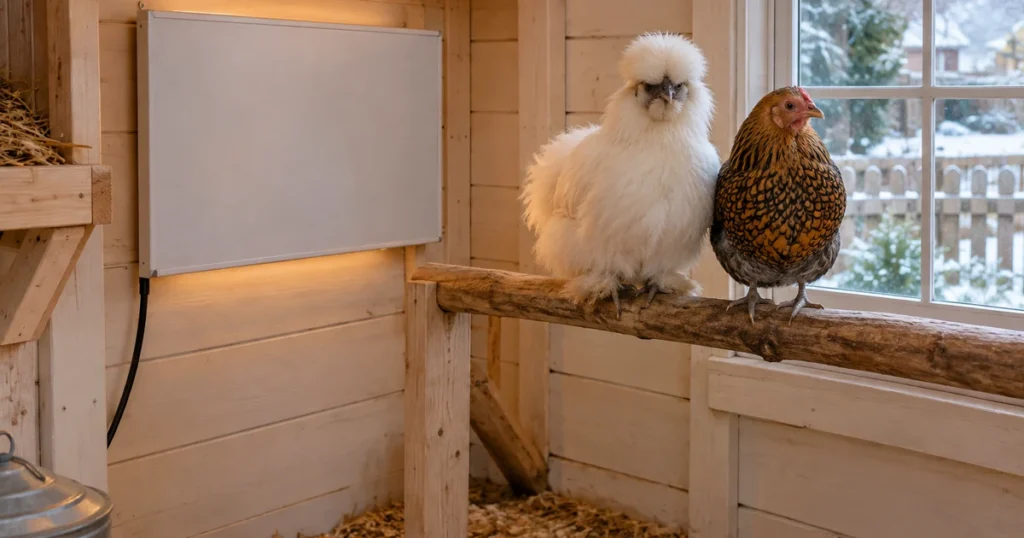
Most healthy adult chickens do not need a coop heater, even in a cold US winter. When heat does make sense, for bantams, Silkies, sick or molting birds, chicks or long stretches of extreme sub-zero cold, the safest choice is a radiant flat-panel heater made for coops, firmly mounted and controlled by a thermostat. A bulb-style heat lamp is the riskiest option, because it is a well-known cause of coop fires.
Quick answer
- A dry, draft-free, ventilated coop keeps hardy hens warm without heat.
- Add heat only for vulnerable birds or extreme, prolonged cold.
- Radiant panels made for coops are the safest heaters; heat lamps the riskiest.
- Mount any heater solidly, keep it away from bedding, and pair it with a thermostatic outlet.
- Use a GFCI outlet and a heavy-duty outdoor cord, and clean dust off often.
In this guide
- Do chickens need a heater in the coop?
- When a coop heater makes sense
- Chicken coop heater types compared
- Sweeter Heater and other radiant panel heaters
- Chicken coop heat lamp: why it is so risky
- What is the safest way to heat a chicken coop?
- How warm should a chicken coop be in winter?
- Common mistakes to avoid
- FAQ
Do chickens need a heater in the coop?
For most flocks, no. A chicken’s body runs around 106°F (41°C), and its down feathers, fluffed up, trap warm air like a sleeping bag. Birds that experience fall cooling acclimate and grow a thicker coat. University of Maine Extension has said plainly that chickens do not need a heat source in winter, and University of New Hampshire Extension advises against supplemental heat in most cases because of the fire risk around bedding.
Not every source agrees. University of Minnesota Extension suggests providing supplemental heat at roost or nest-box height when coop temperatures fall below 35°F (2°C). So treat heat as a decision, not a default. The things that keep chickens warm, ventilation, flat roosts, deep litter and windbreaks, are covered in our pillar guide on how to keep chickens warm in winter.
There is also a practical argument against heating a hardy flock: if the power goes out on the coldest night, birds used to a heated coop face a sudden temperature drop they have not adapted to.
When a coop heater makes sense
- Bantams and small breeds: small bodies lose heat faster.
- Silkies and frizzles: their fluffy feathers insulate poorly and soak through when wet.
- Molting birds: a hen in a hard molt with bare patches has lost much of her insulation.
- Sick, injured or elderly birds: a bird that is fighting illness has less energy to stay warm. If a hen is lethargic, hunched or not eating, contact an avian vet; see our list of sick chicken signs.
- Prolonged extreme cold: days on end well below 0°F (-18°C), especially in a small or uninsulated coop.
- Chicks: always need heat. Penn State Extension recommends about 95°F at chick level the first week, dropping roughly 5°F per week until they are feathered out.
Often the better fix is targeted: a heated brooder or a small, separate heated area for the few birds that need it, rather than heating the whole flock.
Chicken coop heater types compared
| Heater type | How it heats | Fire risk | Verdict |
|---|---|---|---|
| Radiant flat panel made for coops | Low, even radiant warmth to birds near it | Lower: sealed surface, no exposed bulb | Best choice when heat is needed |
| Overhead radiant heater (brooder-style) | Radiant warmth from above | Lower if mounted on chains | Good for chicks and small groups |
| Brooder heating plate | Birds sit under a warm plate | Low | Best for chicks, not adult roosts |
| Heat lamp (250 W bulb) | Infrared bulb, very hot surface | High: bulbs around 500°F, falls, shattering | Avoid in coops when possible |
| Ceramic heat emitter | Bulb-shaped element, no light | High: very hot surface, same mounting issues | Not recommended |
| Household space heater | Fan or coil heating air | High: dust, feathers, tip-overs | Not designed for coops |
| Propane, kerosene or other fuel heater | Open flame or combustion | Very high, plus combustion gases | Never in a closed coop |
Sweeter Heater and other radiant panel heaters
Radiant panel heaters are the type most often recommended for coops. They warm the birds and surfaces close to them rather than trying to heat all the air in a drafty, ventilated building. Brands such as Sweeter Heater make overhead and side-mount panels in several sizes; the maker lists a 150 W, 11 by 40 inch overhead model, and says its lens surface runs about 160 to 180°F, hot to the touch but far below a heat lamp bulb. It also includes a built-in thermostat that shuts the unit off if heat cannot escape.
Other wall-mounted flat panels sold for coops work on the same idea. What to look for:
- Designed and labeled for poultry or livestock buildings.
- Sealed surface that resists dust, feathers and moisture.
- Mounting hardware for screws or chains, not a clamp.
- A listing from a recognized testing lab such as UL or ETL.
- Wattage that fits your coop and birds; for a small backyard coop, a low-wattage panel is usually enough to take the edge off.
University of Minnesota Extension suggests placing supplemental heat at roost or nest-box height so birds can move toward or away from it. Mount panels beside the roost, not under it, so droppings do not land on the heater, and leave room for birds to move off if they get too warm.
Gear that helps
- Radiant flat-panel coop heater: Lower surface temperature and no exposed bulb make it a safer alternative to heat lamps.
As an Amazon Associate we earn from qualifying purchases. Check current prices and reviews on Amazon.
Chicken coop heat lamp: why it is so risky
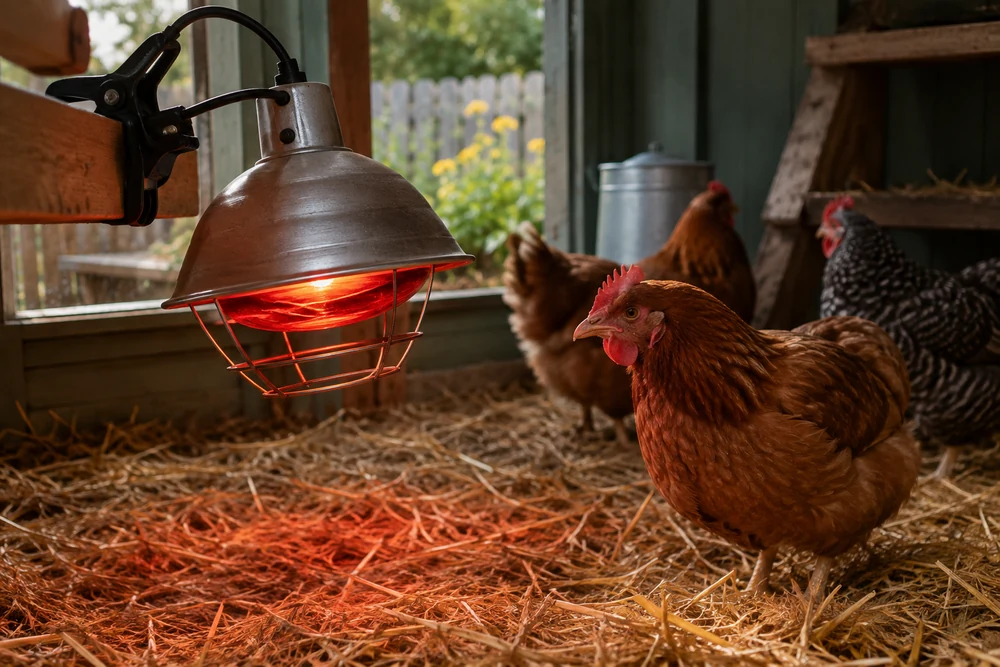
Warning: Heat lamps are one of the leading causes of chicken coop fires in the US, and those fires regularly spread to garages and homes. Fire departments in Utah, Colorado, Missouri, Virginia and North Carolina, among others, have traced coop and house fires to heat lamps.
A heat lamp is a 250 W bulb in an aluminum reflector, often held up by a spring clamp. The bulb surface can reach around 500°F. The Maine Fire Marshal’s office has noted that chickens can knock lamps into the bedding, and straw or shavings can ignite within minutes of touching a hot bulb.
How coop fires start
- Falls: a bird flies into the lamp, a clamp slips, or the lamp hangs by its own cord until the cord fails.
- Bedding contact: a lamp tilts or hangs too low and heats straw, shavings or nesting material until they ignite.
- Dust: coops are full of fine dust, dander and feathers that settle on bulbs, heaters and outlets and can ignite.
- Shattering: a hot bulb splashed with water or struck by a bird can break and drop hot glass or the filament.
- Cords: indoor extension cords, frayed cords, cords run under boards or through bedding, and overloaded or daisy-chained cords all overheat.
- Rodents and pecking: chewed or pecked insulation exposes live wires.
If you must use a heat lamp
- Use a lamp with a protective wire guard over the bulb; UMN notes a cage helps keep the bulb off the bedding if it falls.
- Never hang it by its cord. Suspend it with a chain or cable, as Penn State Extension advises, and add a second attachment as a backup.
- Keep it at least 20 inches from bedding and other flammable material, the clearance Penn State gives.
- Use a shatter-resistant bulb rated for the fixture.
- Check it daily, and switch to a radiant panel as soon as you can.
Backyard Chickens Mastery
More eggs, healthy hens, zero losses: the step-by-step guide that puts every coop hack in one place, from first flock to fifth winter.
Get the guide ($17)What is the safest way to heat a chicken coop?
The safest approach combines the right heater with a few controls. Use this checklist before you plug anything in.
- Fix the coop first. Stop drafts at roost level, keep vents open up high, add 4 to 6 inches of dry bedding. Our guide to winterizing a chicken coop walks through it.
- Choose a radiant panel made for coops, not a heat lamp or a household space heater.
- Mount it solidly with screws, brackets or chains, clear of the area under the roosts and away from bedding.
- Add a thermostatic outlet. Plug-in thermostatic outlets switch power on only in the cold; one common model turns on at 35°F and off at 45°F. That cuts run time and wear.
- Use a GFCI-protected outlet. The National Electrical Code requires GFCI protection for outdoor 125 V receptacles.
- Use a heavy-duty, outdoor-rated extension cord, as short as possible, rated for more than the heater’s draw. Do not chain cords together.
- Route cords up and out of reach of pecking and chewing, and never through bedding.
- Clean dust off the heater, cord and outlet every week or two.
- Put a smoke alarm or temperature sensor where you will hear or see it, and keep a fire extinguisher by the coop door.
- Keep the coop away from your house if you are building or moving it, so a fire cannot spread easily.
Coop hack: Plug the heater into a thermostatic outlet, then into a GFCI outlet. You get automatic on/off in the cold and shock protection without any extra wiring.
Gear that helps
- Thermostatically controlled outlet: Turns the heater on only in the cold, reducing run time and wear.
- Heavy-duty outdoor extension cord: Outdoor-rated cord avoids the overheating and fraying that start coop fires.
As an Amazon Associate we earn from qualifying purchases. Check current prices and reviews on Amazon.
How warm should a chicken coop be in winter?
You are not trying to make the coop warm. You are trying to take the edge off for birds that need it. University of Minnesota Extension notes that most poultry hold their body temperature with the least effort between 60 and 75°F (16-24°C), but heating a ventilated coop to that range is neither practical nor necessary. Aim to keep vulnerable birds above the hard cold, often just keeping the roost area near or above freezing, while still letting the flock acclimate.
Do not forget water: a heater does not stop waterers from freezing. See our guide to heated chicken waterers.
Common mistakes to avoid
- Adding heat to a hardy flock that does not need it.
- Hanging a heat lamp by its cord or from a single clamp.
- Placing any heater over or near bedding or nest boxes.
- Using household space heaters or fuel-burning heaters in the coop.
- Sealing the coop tight to “hold the heat” and trapping moisture.
- Indoor, damaged or daisy-chained extension cords.
- Never cleaning dust off heaters and outlets.
- Heating the whole flock when only one bird needs extra warmth.
FAQ
Is a heat lamp safe for chickens?
It is the riskiest common option. Bulbs get extremely hot and lamps can fall into bedding. If you use one, secure it with a chain and a backup, keep it at least 20 inches from flammable material and check it daily.
At what temperature do chickens need a heater?
Healthy, acclimated adult hens usually manage well below freezing without heat. Some extension services suggest adding heat when the coop drops below 35°F, but many keepers only add it for bantams, Silkies, sick or molting birds, or extreme sub-zero cold.
Is a Sweeter Heater worth it?
If you have birds that need heat, a radiant panel like a Sweeter Heater is a safer choice than a heat lamp because it runs much cooler at the surface and has no exposed bulb. Most hardy flocks do not need one at all.
Can I use a space heater in a chicken coop?
Household space heaters are not designed for dusty, feather-filled coops and can tip over. Choose a heater built for poultry or livestock buildings instead.
Do chicks need a heat lamp?
Chicks need heat, but not necessarily a heat lamp. Brooder heating plates and radiant panels provide the warmth with lower fire risk.
Keep reading
Sources
- Caring for chickens in cold weather – University of Minnesota Extension
- Brooding of Domestic Fowl – Penn State Extension
- How Should I Take Care of Backyard Chickens in the Winter? – University of New Hampshire Extension
- Winter and Your Backyard Chickens – Ohio State University Extension
- Don’t put heat lamps in your chicken coop (Maine Fire Marshal, UMaine Extension) – Bangor Daily News
- Chicken coop fire prompts safety reminders from firefighters – KSL
- Sweeter Heater FAQ – Sweeter Heater
- NEC Requirements for Ground-Fault Circuit Interrupters – EC&M