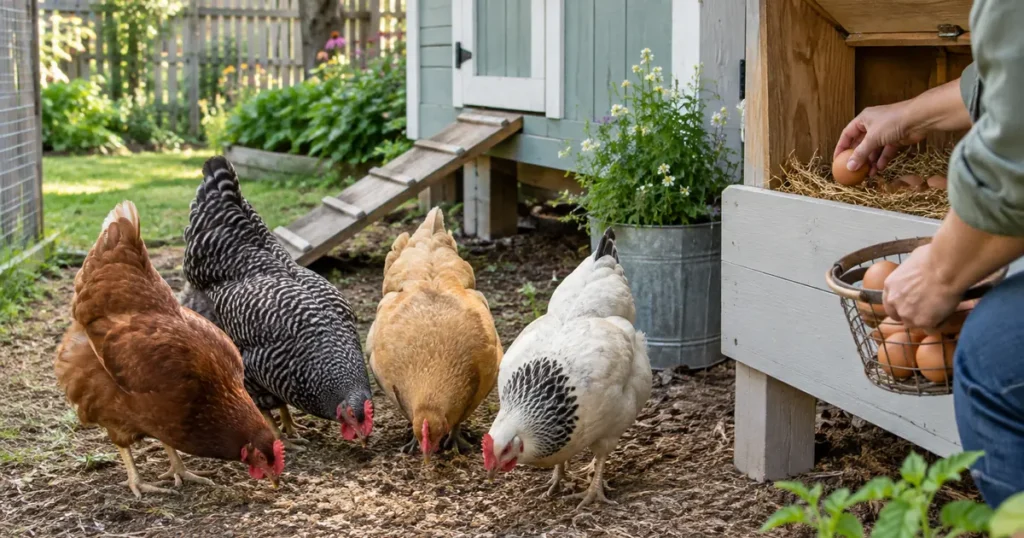
Most beginners should get 3 to 6 hens. Three is the minimum for a happy flock, and a good-laying hen averages about 3 to 5 eggs a week over a full year, so 4 to 6 hens covers a typical family of four. To find your exact number, start with how many eggs your household eats each week, then allow for winter slowdowns, molting and aging hens.
Quick answer
- Minimum flock: 3 hens. Chickens are social and stress when kept alone.
- A hen lays at most one egg a day, roughly 5 to 6 a week at her peak and about 3 to 4 a week averaged over the year.
- Family of 4 eating about 2 dozen eggs a week: plan on 6 to 8 hens.
- Check your city code and HOA first. Many towns cap the number of hens and ban roosters.
- Every extra hen adds coop space, run space, feed and cleaning time.
In this guide
How many eggs does a chicken lay a day?
A healthy laying hen lays at most one egg a day, and usually less. Forming a single egg takes about 25 to 26 hours, according to Poultry Extension (extension.org), so each day she tends to lay a little later than the day before. Hens rarely release a new yolk late in the afternoon, so after a late egg she skips a day and starts a new cycle the next morning.
These runs of daily eggs followed by a day off are called clutches. Top hybrid layers have long clutches and few days off; heritage breeds take more breaks. Either way, no hen lays two eggs a day on a regular basis.
How many eggs does a chicken lay a week?
At her peak, a good layer gives about 5 to 6 eggs a week. University of Minnesota Extension describes roughly six eggs a week for a productive hen, with peak production in her first two years. But that number does not hold all year:
- Spring and early summer: 5 to 6 eggs a week for strong layers, 3 to 5 for heritage breeds.
- Late fall and winter: production drops as days shorten. UF/IFAS Extension notes hens need about 14 hours of light to keep laying steadily. Many backyard hens drop to 0 to 3 eggs a week in winter. See whether chickens lay eggs in winter for details.
- Molt: most hens take a break of several weeks in fall while they regrow feathers.
- Aging: UNH Extension notes a 10-hen flock that starts at about 9 eggs a day eases off to 6 or 7 a day after about 13 months of lay, and many hens slow down significantly after two or three years.
Averaged over a year, that works out to roughly 3 to 4 eggs per hen per week for a young, well-managed flock. UNH Extension’s figure of about 20 dozen eggs per hen over 13 months is a useful real-world benchmark.
Egg math: how many chickens do I need for my family?
Use this table to answer “how many chickens do I need?” It is based on 4 eggs per hen per week for young high-production layers (such as ISA Browns or Golden Comets) and 3 per week for heritage breeds or hens over two years old, rounded up and never below three birds.
| Eggs your household eats per week | Hens needed (young hybrid layers) | Hens needed (heritage or older hens) | Typical household |
|---|---|---|---|
| 6 (half a dozen) | 3 | 3 | 1-2 people, light egg eaters |
| 12 (1 dozen) | 3 | 4 | Couple |
| 18 (1.5 dozen) | 5 | 6 | Family of 3-4, moderate |
| 24 (2 dozen) | 6 | 8 | Family of 4 |
| 30 (2.5 dozen) | 8 | 10 | Family of 5, lots of baking |
| 36 (3 dozen) | 9 | 12 | Large family or sharing with neighbors |
In spring you will likely have more eggs than this, and in December fewer. If you want a steady winter supply, add one or two hens to the figure above or plan to store extra eggs from the spring flush.
How many chickens for a family of 4?
A family of four that eats eggs for breakfast a few times a week plus some baking typically uses 1.5 to 2 dozen eggs a week. That points to 5 to 6 young hybrid layers or 6 to 8 heritage hens. If your kids want pet chickens more than a full egg supply, 4 calm hens is a happy middle ground.
Coop hack: Before you order chicks, tally every egg your household uses for two weeks, including baking. Divide the weekly total by 3.5 and round up. That single number is a better starting point than any online “chickens per person” rule.
Gear that helps
- Egg cartons / egg storage: Families with 4 to 8 hens quickly need storage for the spring egg surplus.
As an Amazon Associate we earn from qualifying purchases. Check current prices and reviews on Amazon.
Why you should never keep just one or two chickens
Chickens are flock animals. Veterinary and extension guidance agrees that a single chicken should not be kept alone; PetMD recommends at least three hens, with six being an easy number for beginners. A lone hen can become stressed, noisy and less productive.
Two hens works on paper, but if one dies or gets sick, the other is suddenly alone, and adding a single new bird to one established hen is tricky. Starting with three or more gives you a buffer. Since many hatcheries and feed stores also have minimum orders for chicks, three to six is the natural starting range.
Check local laws and HOA rules first
Before you decide how many chickens to get, find out how many you are allowed to keep. Rules vary widely from city to city, even inside the same state. A University of Kentucky publication on urban poultry gives examples from three Kentucky cities with different caps (five, six and ten birds), with and without a rooster allowance. It also warns that many HOAs prohibit chickens entirely.
When you check, look for:
- The maximum number of hens allowed, which may depend on lot size.
- Whether roosters are allowed. Many towns restrict or ban them because of crowing. You do not need a rooster for hens to lay eggs.
- Setback rules (how far the coop must be from property lines or neighbors’ homes).
- Whether you need a permit, license or neighbor approval.
- Your HOA covenants, which can be stricter than the city code.
Search for your city’s municipal code online, or call your city planning or zoning office. Your county extension office can also point you in the right direction.
Space, cost and time: how flock size scales
Each hen you add needs room and food. A common planning standard is about 4 sq ft of coop floor and 8 to 10 sq ft of run per standard-size hen; see our chicken coop size guide for full dimensions, roosts and nesting boxes. For feed, University of Minnesota Extension estimates a 6-lb hen eats about 3 lbs of feed per week, and UNH Extension cites 90 to 100 lbs per hen over 13 months for lighter layers.
| Hens | Coop floor | Run | Nesting boxes | Feed per year (approx.) |
|---|---|---|---|---|
| 3 | 12 sq ft | 24-30 sq ft | 1-2 | 250-450 lbs |
| 4 | 16 sq ft | 32-40 sq ft | 1-2 | 350-600 lbs |
| 6 | 24 sq ft | 48-60 sq ft | 2 | 500-900 lbs |
| 8 | 32 sq ft | 64-80 sq ft | 2 | 700-1,200 lbs |
| 10 | 40 sq ft | 80-100 sq ft | 2-3 | 900-1,500 lbs |
Feed is your biggest ongoing cost, followed by bedding, and both scale almost directly with flock size. Daily chores (feeding, water, collecting eggs) take about the same time for 4 hens as for 8, but cleaning the coop and managing pecking order get harder as numbers grow. Bigger flocks also mean more birds at risk if disease comes in; good biosecurity matters at any size.
Warning: Avian influenza (HPAI) has affected US backyard and commercial flocks in recent years. Keep wild birds away from feed and water, limit visitors to your coop, and report sudden deaths or several sick birds to your state veterinarian or USDA APHIS. For any individual hen that is lethargic, not eating or breathing hard, contact an avian vet or your state poultry lab.
Plan for “chicken math”
Many keepers end up with more birds than they planned, because chicks are cute and feed stores are tempting. Build or buy a coop one size bigger than your starting flock. If you start with 4 hens, a coop and run sized for 6 gives room to add birds later without crowding. Our beginner’s guide to backyard chickens covers the full setup.
Backyard Chickens Mastery
More eggs, healthy hens, zero losses: the step-by-step guide that puts every coop hack in one place, from first flock to fifth winter.
Get the guide ($17)Gear that helps
- Large-capacity chicken feeder: Feed scales with flock size; a larger feeder reduces refills and waste.
As an Amazon Associate we earn from qualifying purchases. Check current prices and reviews on Amazon.
Common mistakes to avoid
- Getting a single chicken. A lone hen is a stressed hen. Start with at least three.
- Planning on one egg per hen per day. Use 3 to 4 eggs a week as your yearly average.
- Forgetting winter and molt. Expect fewer eggs from late fall to early spring.
- Skipping the city code and HOA check. Having to rehome hens is heartbreaking and avoidable.
- Buying the coop for your starting number only. Size up for the hens you may add later.
- Keeping old hens without planning for replacements. Production falls after year two or three, so many keepers add a few pullets every couple of years.
FAQ
How many chickens should I get as a beginner?
Start with 3 to 6 hens. That gives a stable social group and a useful supply of eggs without overwhelming you with chores or coop costs.
How many eggs will 3 chickens lay a week?
Three young, productive hens lay about 9 to 15 eggs a week in spring and summer, and fewer in winter. Over a full year, plan on roughly a dozen a week.
How many chickens do I need for a dozen eggs a week?
About 3 young hybrid layers or 4 heritage hens will give you around a dozen eggs a week averaged across the year.
Can you have just 2 chickens?
It is possible, but three is safer. If one of two hens dies, the survivor is left alone, which is stressful for a flock animal.
Do I need a rooster to get eggs?
No. Hens lay eggs without a rooster. A rooster is only needed for fertilized eggs, and many cities do not allow them.
How many eggs does a chicken lay in a year?
A young, productive hen typically lays about 200 to 300 eggs in her first year, depending on breed. Production then declines with age.
Keep reading
Sources
- Raising chickens for eggs – University of Minnesota Extension
- Producing Your Own Eggs – UNH Cooperative Extension
- Factors Affecting Egg Production in Backyard Chicken Flocks – UF/IFAS Extension
- Avian Reproductive System: Female – Poultry Extension (extension.org)
- Urban Poultry (ASC-241) – University of Kentucky Cooperative Extension
- Backyard Chickens: A Pet Parent’s Guide – PetMD