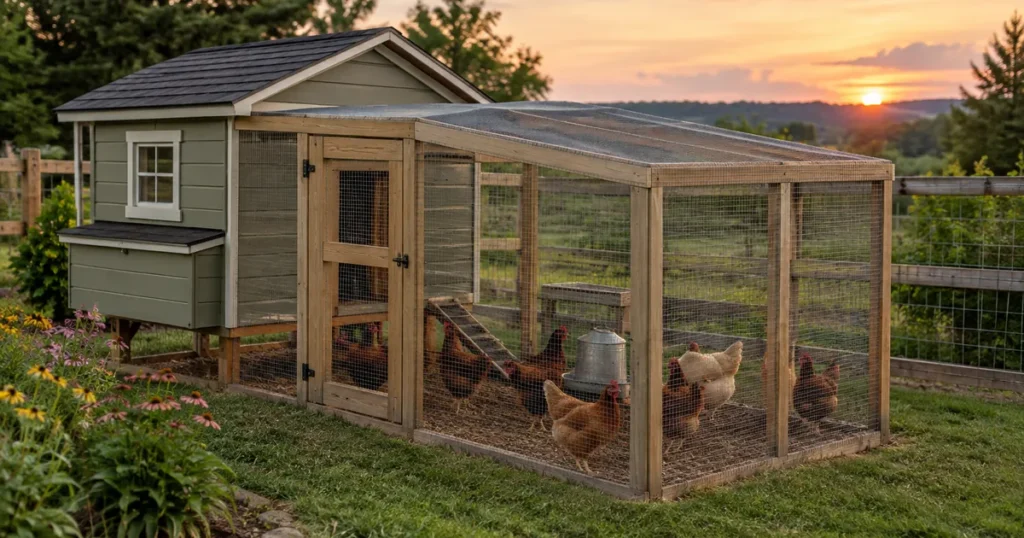
A predator-proof chicken coop has no gap larger than 1/2 inch, walls and vents covered with welded hardware cloth instead of chicken wire, a buried or flat wire apron that stops diggers, two-step latches raccoons can’t open, and a covered run that keeps out hawks and owls. Close it every night, by hand or with an automatic door, and most losses stop.
Quick answer
- Use 1/2-inch hardware cloth on every opening: runs, windows and vents. Chicken wire keeps chickens in, not predators out.
- Add an apron or skirt of hardware cloth 12 to 24 inches out from the base, buried or pinned flat, to stop digging.
- Raccoons open simple hooks and slide bolts; use two-step latches or carabiners.
- Cover the run against hawks and owls. Both are federally protected, so never harm them.
- Most attacks happen at night, at dawn or at dusk: lock birds in before dark.
In this guide
- What kills chickens at night?
- How to protect chickens from predators: identify the culprit
- Hardware cloth vs chicken wire
- How to build a predator-proof chicken coop: step by step
- Do possums eat chickens?
- How to keep hawks away from chickens
- Lights and other deterrents: do they work?
- Common mistakes to avoid
- FAQ
What kills chickens at night?
Most night losses come from raccoons, opossums, owls (great horned owls especially), weasels and mink, skunks, rats and, in many areas, foxes and coyotes. Daytime attacks are more often hawks, dogs, foxes and bobcats.
The good news: almost every night predator either climbs, digs or squeezes through small gaps. A closed coop built with the right wire, latches and apron defeats all three.
How to protect chickens from predators: identify the culprit
If you’ve already lost a bird, the scene tells you a lot. Use this table to narrow down who did it and how to stop them. Signs overlap, so treat it as a guide, not proof.
| Predator | Signs left | When | Best defense |
|---|---|---|---|
| Raccoon | Several birds killed; breast and crop torn and eaten; heads pulled through wire; eggs gone | Night | 1/2-inch hardware cloth, two-step latches, solid floor or apron |
| Opossum | Usually one bird killed or mauled, feeding often starts at the vent; eggs and chicks eaten | Night | Close every gap; lock coop at night; collect eggs daily |
| Fox | Bird missing or killed with bites to neck and back; few feathers; carcass carried off | Dawn, dusk, sometimes day | Buried apron, tall fence, electric wire outside the run |
| Coyote | Birds missing, feather trail; attacks in daylight on free-ranging birds | Dawn, dusk, daytime | Tall fencing with apron, electric wire, supervised free-ranging |
| Hawk | Daytime loss; bird plucked cleanly on site or missing; feathers scattered in open areas | Day | Covered run, shrubs or shelters for cover, avoid open free-ranging |
| Owl | Bird missing or head eaten; attacks on birds roosting outside | Night | Covered run, lock birds inside at night |
| Weasel or mink | Many birds killed with bites to head and neck, little eaten; small entry holes | Night | Seal gaps; 1/4-inch hardware cloth on low areas and vents |
| Snake | Eggs and chicks vanish with no mess | Day or night | 1/4-inch mesh near nests and brooders; seal gaps; collect eggs often |
| Rat | Eggs gone, chicks killed or bitten; tunnels and droppings | Night | Hardware cloth floor or apron, feed stored in metal cans |
| Dog | Many birds injured or killed, bites all over, feathers everywhere, little eaten | Day | Sturdy fencing, covered run, talk to neighbors about loose dogs |
| Bobcat | Bird eaten or carried away; may climb fences | Dusk, night, sometimes day | Covered run, locked coop, electric wire |
If the predator keeps returning and you can’t keep it out, contact your state wildlife agency or USDA Wildlife Services. Trapping rules vary by state and species.
Hardware cloth vs chicken wire
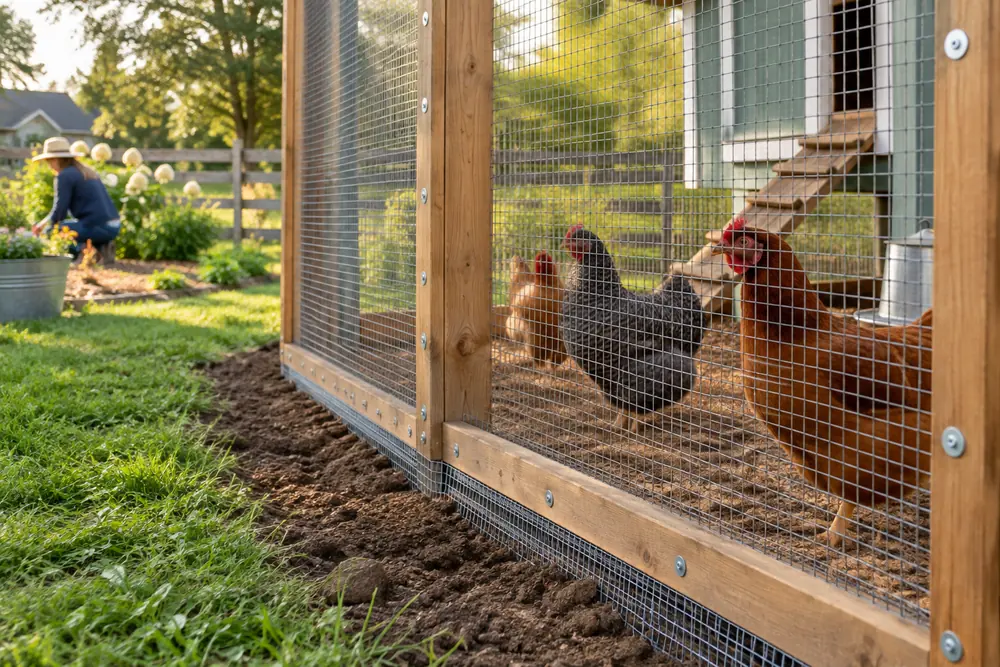
This is the single most important choice you’ll make. Chicken wire is thin, twisted hexagonal mesh. It contains chickens but a raccoon can tear it, and its 1-inch or larger holes let weasels, snakes and rats through. Raccoons can also reach through and grab birds sleeping near the wall.
Hardware cloth is welded, galvanized steel mesh with square openings. The 1/2-inch size (usually 19 gauge) is the standard for coops and runs because it stops raccoons, opossums, foxes and most rats. Go down to 1/4-inch on vents near nests, brooders and low walls if you have weasels or snakes in your area.
| Feature | Chicken wire | 1/2-inch hardware cloth |
|---|---|---|
| Construction | Twisted, thin wire | Welded, galvanized steel |
| Stops raccoons | No | Yes, when well fastened |
| Stops weasels and rats | No | Mostly (use 1/4-inch for weasels and snakes) |
| Cost | Low | Higher |
| Best use | Garden fencing, temporary pens, top of a daytime run | Coop windows, vents, run walls, aprons |
Coop hack: Staples alone pull out when a raccoon yanks on the mesh. Fasten hardware cloth with screws and fender washers every 4 to 6 inches, or sandwich the edge under a wood strip screwed into the frame.
Gear that helps
- 1/2 inch galvanized hardware cloth: The standard mesh that stops raccoons and most predators
As an Amazon Associate we earn from qualifying purchases. Check current prices and reviews on Amazon.
How to build a predator-proof chicken coop: step by step
- Walk the coop with a flashlight. Look for any gap over 1/2 inch, including under doors, around roof edges and where pipes or wires enter. A weasel needs very little space.
- Cover every opening with hardware cloth. Windows and vents need it too: open vents are a classic raccoon entry point.
- Stop the diggers. Lay a skirt (apron) of hardware cloth 12 to 24 inches wide around the base of the run, either buried 12 inches deep or laid flat on the ground and pinned, attached to the bottom of the wall. Penn State Extension recommends burying at least 12 inches and turning the bottom outward about 6 inches.
- Secure the floor. A raised wooden floor or a concrete floor works well. On dirt floors, lay hardware cloth under the bedding.
- Upgrade latches. Raccoons have nimble paws and can open hook-and-eye latches and simple slide bolts. Use two-step latches, spring-loaded latches with a carabiner, or padlock hasps.
- Cover the run. A roof of hardware cloth, welded wire, solid panels or heavy aviary netting keeps out hawks and owls and stops climbing raccoons and bobcats.
- Close up every night. An automatic chicken coop door on a light sensor or timer closes at dusk even when you’re late.
- Add deterrents last. Motion-activated lights, solar flashing predator lights and electric wire along the outside of the run make predators less comfortable, but they don’t replace solid construction.
For layout and space numbers, see our chicken coop size guide. If you’re starting from scratch, our backyard chickens for beginners guide covers the full setup.
Automatic doors and electric fencing
An automatic pop door removes the most common cause of night losses: a door left open. Pick a model that shuts firmly (a vertical guillotine door with a locking mechanism is harder to pry up) and check that every bird is inside before it closes.
Electric wire is one of the most effective ways to protect livestock from mammal predators. A strand about 4 inches off the ground and another near the top of the fence, a few inches outside the run, discourages raccoons, foxes and coyotes from digging or climbing. Follow the energizer’s instructions and check the line regularly for grass shorting it out.
Backyard Chickens Mastery
More eggs, healthy hens, zero losses: the step-by-step guide that puts every coop hack in one place, from first flock to fifth winter.
Get the guide ($17)Gear that helps
- Automatic chicken coop door: Closes the coop at dusk, preventing the most common night losses
- Two-step spring latches and locking carabiners: Raccoons can open simple hooks and slide bolts
As an Amazon Associate we earn from qualifying purchases. Check current prices and reviews on Amazon.
Do possums eat chickens?
Yes. Opossums do eat chickens, especially chicks, young birds and hens roosting on the floor, and they love eggs. They are opportunists rather than strong hunters. According to the Internet Center for Wildlife Damage Management, opossums usually take advantage of existing openings instead of forcing their way in like raccoons.
That makes them easy to stop. Close gaps around doors and pipes, lock the coop at night, keep feed in metal cans with tight lids, and collect eggs every day. If an opossum is already inside, it’s often because a door was left open or a small gap was overlooked.
Opossum attacks are often confused with raccoon or skunk damage. A single mauled bird with feeding that starts near the vent leans toward an opossum; several birds with torn chests and heads pulled through wire point more to a raccoon.
How to keep hawks away from chickens
Hawks hunt in daylight, usually swooping on birds in open yards. Cooper’s hawks and red-tailed hawks are the species backyard keepers meet most often. To protect your flock:
- Cover the run with wire, netting or a solid roof. This is the only fully reliable method.
- Give free-range birds cover: shrubs, a table, a pallet lean-to or an old Christmas tree lets hens dive for safety.
- Avoid big open spaces away from shelter, and keep coops away from tall perch trees when you can.
- Supervise free-ranging during the seasons when hawks hit your yard most.
- Rotate visual deterrents such as reflective tape or scare-eye balloons. Hawks get used to them, so move them often and don’t rely on them alone.
Warning: Hawks, owls, falcons and eagles are protected by the federal Migratory Bird Treaty Act. It is illegal to shoot, trap, poison or harass them in harmful ways, and violations can bring heavy fines and even jail time. Federal permits are not issued for killing raptors that take backyard chickens. Protect your flock with covers and confinement only.
Lights and other deterrents: do they work?
Solar predator lights (small flashing red LEDs) and motion-activated floodlights can make a raccoon or fox hesitate, especially in the first weeks. Results vary, and animals often learn the light is harmless. Treat them as an extra layer on top of a secure coop.
Livestock guardian dogs can protect larger free-range flocks well, but they need training and are a long-term commitment. For a suburban backyard, a solid coop and covered run are simpler and more reliable.
Coop hack: Sprinkle a 2-foot band of sand or fine soil outside the run. Check it in the morning for tracks: you’ll know which predator is testing your defenses before it gets in.
Gear that helps
- Solar predator deterrent lights: An extra night deterrent layer for raccoons and foxes
As an Amazon Associate we earn from qualifying purchases. Check current prices and reviews on Amazon.
Common mistakes to avoid
- Using chicken wire on windows, vents or the run walls and assuming it stops predators.
- Fastening hardware cloth with light staples only.
- Relying on hook-and-eye latches or a simple slide bolt.
- Leaving the run uncovered in an area with hawks or owls.
- Letting hens roost outside or in trees at night.
- Forgetting to close the coop “just once” after dark.
- Leaving feed and spilled grain out overnight, which draws rats and raccoons.
- Trying to trap or harm hawks and owls, which is illegal.
FAQ
What is the best wire for a predator-proof chicken run?
Welded, galvanized 1/2-inch hardware cloth is the standard. Use 1/4-inch near nests, brooders and low vents if weasels or snakes live in your area.
How deep should I bury hardware cloth around a chicken run?
Bury it at least 12 inches deep, or lay a 12 to 24 inch apron flat on the ground, attached to the bottom of the wall and pinned down. Diggers hit the wire and give up.
Will a raccoon kill all my chickens?
A raccoon can kill several birds in one night and often returns for more. Once one finds a weak spot, fix it right away with hardware cloth and better latches.
Can chickens be left in a run at night?
Only if the run is fully enclosed with hardware cloth on all sides, a solid or wired roof and an apron. Otherwise, lock birds in the coop every night.
Do solar predator lights work?
They can deter some night predators for a while, but animals often get used to them. Use them as an extra layer, not as your main protection.
Keep reading
Sources
- Predator Management for Small and Backyard Poultry Flocks – Poultry Extension (extension.org)
- Small Scale Poultry Housing – Penn State Extension
- Opossum Damage Identification – Internet Center for Wildlife Damage Management
- Birds of Prey and Livestock – Connecticut Department of Energy and Environmental Protection
- 5 Things to Know Before Raising Backyard Chickens – Colorado State University