
Water glassing eggs means submerging clean, unwashed eggs in a solution of pickling lime (calcium hydroxide) and water, then storing the jar somewhere cool and dark. Homesteaders report eggs keeping for 8 to 12 months or more this way, without a fridge. Before you try it, know the other half of the story: there is no USDA- or NCHFP-tested procedure for water glassing, and Penn State and Utah State extension both advise against it. If you go ahead, use only spotless, unwashed, uncracked eggs and cook them thoroughly.
Quick answer
- The most commonly used ratio is 1 ounce (about 28 g) of food-grade pickling lime per 1 quart (about 1 liter) of water.
- Use only clean, unwashed, uncracked eggs with their bloom intact. Never water glass store-bought or washed eggs.
- Reported storage life is 8 to 12 months or longer, based on homesteaders’ experience, not on lab testing.
- As of October 2026, no USDA or National Center for Home Food Preservation guidance covers water glassing; extension services call it not recommended.
- Wear gloves when handling lime, rinse eggs before use and use them only in fully cooked dishes.
In this guide
- What is water glassing?
- Is water glassing safe?
- What you need to water glass eggs
- How to water glass eggs, step by step
- How long do water-glassed eggs last?
- How to use water-glassed eggs safely
- Handling pickling lime safely
- Water glassing vs other ways to store eggs
- When water glassing makes sense (and when it doesn’t)
- Common mistakes to avoid
- FAQ
What is water glassing?
The name is older than the method most people use today. “Water glass” originally meant sodium silicate, a syrupy liquid that farm families mixed with water to preserve spring eggs before home refrigerators were common. A 1917 Utah Agricultural College circular, for example, called for 1 quart of water glass to 10 quarts of boiled, cooled water. Recipes using limewater instead go back even further, to American household books of the 1830s and 1850s.
Today, most backyard keepers who “water glass” actually use pickling lime: food-grade calcium hydroxide sold in the canning aisle. The name stuck even though the ingredient changed. The idea is the same in both versions: the egg sits in a strongly alkaline bath that keeps out air and discourages bacteria, so it ages very slowly.
Is water glassing safe?
This is the question to settle before you mix anything. Here is where the official guidance stands as of October 2026:
- No tested recipe exists. Neither USDA nor the National Center for Home Food Preservation (NCHFP), the main US source of tested home preservation methods, publishes a water-glassing procedure or a safe storage time for it.
- Penn State Extension says it is not recommended. Discussing the original sodium silicate version, it reports that the method is ineffective at preserving egg white quality at room temperature and that pathogens can enter through the shell pores.
- Utah State University Extension says it is not considered safe for long-term storage, partly because Salmonella Enteritidis can be inside an egg before it is laid, and no outside coating can fix that.
- USDA’s standard advice is to keep raw shell eggs at 40°F (4°C) or below and use them within 3 to 5 weeks.
So the fair summary is this: water glassing is a traditional method with plenty of good reports from homesteaders, but it has not been tested to modern food-safety standards, and you take on that risk yourself. If anyone in your home is pregnant, very young, older or has a weakened immune system (the groups FDA lists as most at risk from Salmonella), stick with the fridge and freezer.
What you need to water glass eggs
- Food-grade pickling lime (calcium hydroxide), sold for canning. Do not use garden lime, agricultural lime, quicklime or builder’s lime.
- Fresh, clean, unwashed, uncracked eggs from your own flock, ideally collected within a day or two.
- A glass jar or food-grade plastic bucket with a lid. Avoid metal containers and metal lids, which the alkaline solution can corrode.
- Clean water. Many keepers use distilled or filtered water; whether tap water chemistry matters has not been studied.
- A kitchen scale, so you weigh the lime instead of guessing.
- Waterproof gloves and safety glasses for handling lime.
Gear that helps
- Food-grade pickling lime (calcium hydroxide): The ingredient the method relies on; must be food grade, not garden lime.
- Wide-mouth glass jars with plastic lids: Non-metal containers that will not corrode in the alkaline solution.
As an Amazon Associate we earn from qualifying purchases. Check current prices and reviews on Amazon.
How to water glass eggs, step by step
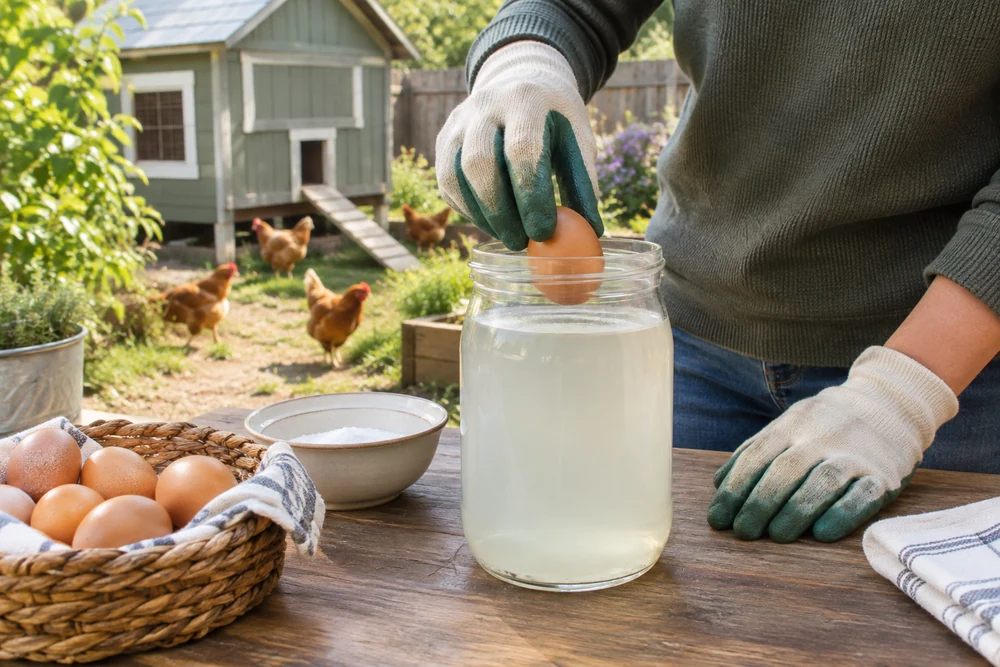
- Choose your eggs carefully. Use only eggs that came out of the nest clean. Do not wash them, wipe them with a damp cloth or float-test them, because water weakens the bloom. Check each one for hairline cracks; candling with a flashlight helps. Set aside any egg with dirt, droppings or a thin, rough shell.
- Put on gloves and glasses. Pickling lime is caustic, and the fine powder irritates eyes and skin.
- Mix the solution. Stir 1 ounce (about 28 g) of pickling lime into each 1 quart (about 1 liter) of water. This is the ratio most widely shared by homesteading sources, such as the Farmers’ Almanac. Lime dissolves only partly, so some will settle on the bottom; that is normal.
- Add the eggs gently. Lower them one at a time with a spoon or gloved hand, small end down, so none crack.
- Keep them covered. Leave at least 2 inches (5 cm) of solution above the top eggs. Any egg sticking out of the liquid is no longer protected.
- Cover and label. Put on the lid and write the start date (and later the end date) on it.
- Store cool and dark. A basement, cellar or cool pantry with a steady temperature works better than a garage that swings from hot to cold.
Many keepers add eggs to the same jar over several days as hens lay. If you do, keep every egg fully submerged and record the first and last dates so you know the age range in each jar.
Coop hack: Use several smaller jars instead of one big bucket. Fill one jar per week during the spring flush, date each lid, and open them oldest first. If one jar ever smells off, you lose a few eggs instead of your whole stash.
How long do water-glassed eggs last?
Most homesteading sources report 8 to 12 months, and some claim 18 months or more. Keep in mind that these numbers come from personal experience, not controlled testing. No agency has established a safe storage time.
Even when eggs keep well, quality changes. Expect runnier whites, yolks that break more easily and whites that may not whip as well for meringue. That matches Penn State’s finding that the method does not hold egg white quality well at room temperature.
How to use water-glassed eggs safely
- Remove eggs with gloves or a clean slotted spoon.
- Rinse each egg under running water to remove the lime residue.
- Crack each egg into a separate bowl and sniff. Throw out any egg with an off smell, odd color or cracked shell, and throw out the whole jar if the solution smells foul or shows mold or slime.
- Use it right away. Once out of the solution and rinsed, the egg is no longer protected.
- Cook it thoroughly. Use water-glassed eggs in baked goods, casseroles, quiche or eggs scrambled until firm. FDA and CDC advise cooking egg dishes to 160°F (71°C). Skip them for runny yolks, homemade mayonnaise, eggnog or anything raw or lightly cooked.
Handling pickling lime safely
Calcium hydroxide is the same ingredient used in canning and in making corn tortillas, but in concentrated form it is a strong alkali. Treat it with respect.
- Wear waterproof gloves and safety glasses when measuring and mixing.
- Pour slowly to avoid a dust cloud, and do not breathe the powder.
- Keep the bag and the jars out of reach of children and pets, clearly labeled.
- If lime gets on your skin, rinse well with water. If it gets in your eyes, flush with running water for several minutes and seek medical care.
- Read and follow the safety information on the product label.
Warning: Never drink, taste or cook with the soaking solution, and never substitute non-food-grade lime. Builder’s or garden lime can contain impurities that do not belong anywhere near food.

The complete guide · 2027 Edition
Backyard Chickens Mastery
Want steadier eggs all year? More eggs, healthy hens, zero losses: every coop hack in one step-by-step guide.
- 188 pages, 9 parts, 70 Coop Hacks
- 20 breed profiles, a 60-food safe chart and a laying troubleshooter
- 9 printable checklists, including the Winter Egg-Laying Checklist
Gear that helps
- Nitrile gloves and safety glasses: Protects skin and eyes from caustic lime dust and solution.
As an Amazon Associate we earn from qualifying purchases. Check current prices and reviews on Amazon.
Water glassing vs other ways to store eggs
Water glassing is one option among several. This table compares it with methods that have tested or official guidance.
| Method | How long | Pros | Cons | Tested guidance? |
|---|---|---|---|---|
| Refrigerator, 40°F (4°C) or below | 3 to 5 weeks (USDA); often longer for clean unwashed eggs | Simple, safest everyday option | Fridge space; not for long-term surplus | Yes (USDA, FDA) |
| Counter, unwashed only | About 2 weeks | No fridge needed | Short; quality drops fast when warm | Extension guidance (Ohio State) |
| Freezing, cracked and beaten | Up to about 12 months for best quality | Reliable, easy, good for baking | Freezer space; needs power | Yes (NCHFP) |
| Pickled eggs, refrigerated | Use within 3 to 4 months | Ready-to-eat snack | Must stay refrigerated; cooked eggs only | Yes (Penn State) |
| Water glassing (pickling lime) | 8 to 12+ months reported | No power, low cost, whole eggs | Untested; quality loss; risk on you | No |
| Home dehydrator | Not recommended | Compact powder | Utah State says home dehydrators do not reach high enough temperatures | Advised against |
| Freeze-drying | Long-term | Shelf-stable powder | Expensive equipment | Presented as an option by Utah State |
For most backyard keepers, the fridge plus the freezer covers the spring glut safely. Our guide to how long fresh eggs last on the counter and in the fridge explains the everyday side of egg storage.
When water glassing makes sense (and when it doesn’t)
Water glassing appeals most to keepers who have more eggs in spring and summer than they can use, and fewer in late fall and winter, when shorter days and molting slow laying. If that winter gap is your main problem, our guide to why chickens stop laying eggs covers ways to keep some eggs coming.
It makes less sense if your household includes high-risk people, if your fridge and freezer have room, or if your eggs are often dirty from the nest. In those cases, freezing beaten eggs, sharing extras with neighbors or adjusting flock size with our how many chickens should I get guide are safer ways to handle a surplus.
Common mistakes to avoid
- Using store-bought eggs. They have been washed, so the bloom is gone.
- Washing, wiping or float-testing eggs before putting them in the jar.
- Including eggs with hairline cracks, thin shells or dirt.
- Using garden lime, quicklime or builder’s lime instead of food-grade pickling lime.
- Guessing the amount of lime instead of weighing it.
- Letting the solution level drop so the top eggs are exposed.
- Storing jars in a hot garage, shed or sunny spot.
- Skipping gloves and eye protection.
- Serving water-glassed eggs soft-boiled, runny or raw.
- Assuming that because the method is old, it has been tested.
FAQ
Is water glassing eggs safe?
It has not been tested by USDA or the National Center for Home Food Preservation, and Penn State and Utah State extension advise against it. Many homesteaders use it without problems, but the risk is yours. Use only clean, unwashed eggs and cook them thoroughly.
What is the ratio for water glassing eggs?
The most commonly used ratio is 1 ounce (about 28 g) of food-grade pickling lime per 1 quart (about 1 liter) of water. Weigh the lime with a kitchen scale and expect some of it to settle on the bottom.
How long do water-glassed eggs last?
Homesteaders commonly report 8 to 12 months, sometimes longer, in a cool, dark place. These are personal reports, not tested storage times, and egg quality declines over that period.
Can you water glass store-bought eggs?
No. US store eggs are washed before sale, which removes the protective bloom. Only clean, unwashed eggs from your own flock are suitable.
Do you need to refrigerate water-glassed eggs?
Not while they are in the solution; jars are kept in a cool, dark place. Once you take an egg out and rinse it, use it right away in a fully cooked dish.
Keep reading
Sources
- How to Safely Handle and Store Eggs from Your Home Flock – Penn State Extension
- Storing Eggs Safely – Utah State University Extension
- Shell Eggs from Farm to Table – USDA Food Safety and Inspection Service
- What You Need to Know About Egg Safety – U.S. Food and Drug Administration
- Freezing Eggs – National Center for Home Food Preservation
- Backyard Poultry – Centers for Disease Control and Prevention
- Let’s Learn About Proper Egg Storage from Your Backyard Chickens – Ohio State University Extension
- Water Glassing Eggs: How to Preserve Your Harvest (source of the commonly used lime ratio) – Farmers’ Almanac
- Grandma’s Eggs: Historical Egg Preservation – Farm Collector