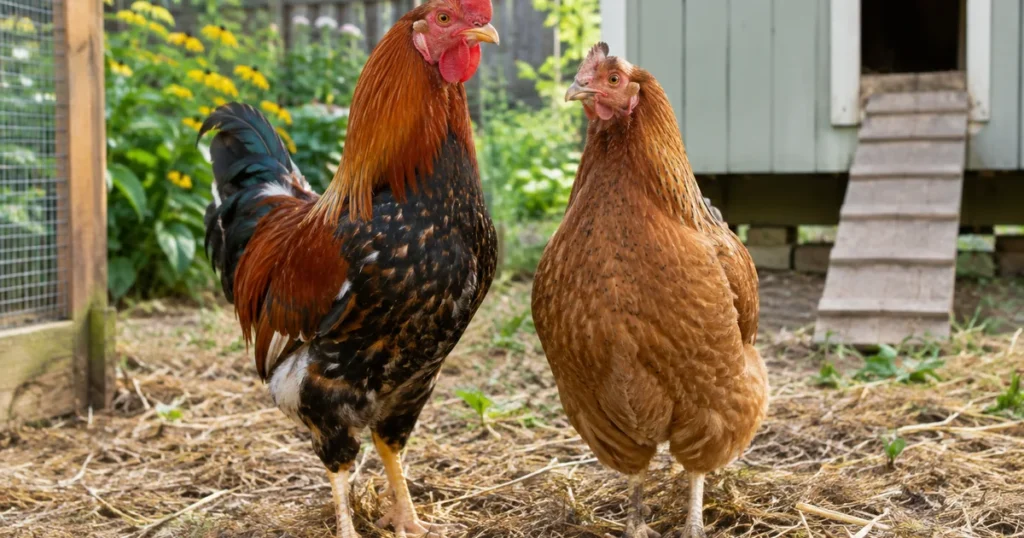
The surest way to tell a hen from a rooster is to wait and watch: by about 4 to 6 weeks, young males usually show bigger, redder combs and wattles, and by a few months old they grow pointed hackle and saddle feathers and start to crow. Day-old chicks are much harder to read unless they are a sex-link cross or a feather-sexable strain. Vent sexing exists, but it is a professional hatchery skill, not something to try at home.
Quick answer
- Combs and wattles: males’ grow larger and redden earlier, often visible around 4 to 6 weeks.
- Feathers: roosters grow long, pointed hackle (neck) and saddle (lower back) feathers; hens’ are short and rounded. Only males have saddle feathers.
- Crowing is the clearest sign, but it can start anywhere from a few weeks to several months of age.
- Sex-link chicks (Red Star, Black Star, Golden Comet and similar) can be sexed by down color at hatch.
- Vent sexing is for trained professionals; handling a chick’s vent at home can injure it.
In this guide
- Why it matters to know a hen from a rooster
- How to tell if a chick is a rooster: signs by age
- Hen vs. rooster: 7 physical and behavior differences
- Sex-link chickens: sexing by color at hatch
- Feather sexing: what it is and when it works
- Vent sexing: leave it to professionals
- Sexing chicks: myths that do not work
- Sexed pullets vs. straight run: what you are buying
- What to do if you end up with a rooster
- Common mistakes to avoid
- FAQ
Why it matters to know a hen from a rooster
If you want eggs, you want hens. Roosters do not lay, and many US towns that allow backyard hens ban roosters because of noise. Knowing early whether you have a cockerel (a young male) gives you time to plan, whether that means keeping him, rehoming him or exchanging him where a seller offers it.
A quick reminder on terms: a young female is a pullet and an adult female is a hen; a young male is a cockerel and an adult male is a rooster or cock. And you do not need a male for eggs at all, as our guide on whether hens need a rooster to lay eggs explains.
How to tell if a chick is a rooster: signs by age
Every breed develops on its own timeline. Mississippi State University Extension notes that comb and wattle differences usually show at about 4 to 6 weeks, but large, slow-maturing breeds can keep you guessing much longer, and some breeds barely differ for months. Use the table as a rough guide and look for several signs together, not one.
| Age (approximate) | Likely cockerel | Likely pullet | Reliability |
|---|---|---|---|
| Day 1 | Sex-links: males lighter (red sex-link) or with a white head spot (black sex-link). Feather-sexable strains: wing feathers all about the same length. | Sex-links: females red, buff or solid black. Feather-sexable strains: primaries clearly longer than coverts. | High for sex-links; useless for most breeds |
| 1 to 3 weeks | Often slower to feather out, bolder posture | Often feather out faster | Low |
| 4 to 6 weeks | Comb and wattles larger and turning pink to red; thicker legs | Small, pale yellow-pink comb | Moderate |
| 6 to 12 weeks | Comb clearly bigger and red; may stand upright; chest-bumping and sparring | Comb still small; smoother, more refined head | Moderate to good |
| About 3 to 5 months | Pointed, shiny hackle and saddle feathers; longer, curved tail sickles; first crow attempts | Rounded hackle feathers, no saddle feathers, short tail | Good to very good |
| 5 to 6 months and older | Regular crowing, mating behavior, developing spurs | Squatting when touched, red comb, laying begins | Very good |
Pullets of most breeds start laying around 18 to 22 weeks, so the first egg settles the question for good. Our guide to how many eggs a chicken lays covers what to expect from that point.
Gear that helps
- Leg bands for chicks: Number each chick so you can track comb, feather and behavior changes week by week.
As an Amazon Associate we earn from qualifying purchases. Check current prices and reviews on Amazon.
Hen vs. rooster: 7 physical and behavior differences

1. Comb and wattles
Males develop larger combs and wattles, and they color up earlier. In single-comb breeds such as Leghorns, University of Kentucky’s poultry specialist notes that a rooster’s comb stands upright while a hen’s may flop to one side. Compare birds of the same breed and age; a pea-comb Ameraucana and a single-comb Leghorn are not a fair match.
2. Hackle feathers
Hackles are the neck feathers. On a male they become long, narrow and pointed, often glossy, and drape over the shoulders. On a female they are shorter with rounded, oval tips.
3. Saddle feathers
Saddle feathers grow on the lower back, just in front of the tail. Only males have true saddle feathers: long, pointed and often hanging down the sides. A hen’s back feathers stay short and rounded. Saddle feathers are among the most reliable visual signs once they appear.
4. Tail feathers
Mature roosters grow long, curved sickle feathers that arch over the tail. Hens have a shorter, more upright tail without sickles.
5. Body, legs and spurs
Cockerels are usually larger, with thicker legs and a more upright stance. Both sexes can have spur buds, but males develop larger, longer spurs with age, so spurs help more on adults than on chicks.
6. Crowing
A crow is the clearest sign a bird is male. Young cockerels often start with squeaky, broken attempts, sometimes at only a few weeks of age, while others wait several months. Hens normally do not crow. A University of Florida factsheet explains that the full rooster voice depends on male hormones, which is why a crowing hen is rare and usually linked to a hormonal or ovarian problem rather than a sex change.
7. Behavior
Young males tend to stand tall, chest-bump other chicks and face you head-on. As they mature, they guard the flock, call hens to food and start mating. Behavior alone is a weak clue, though: bold pullets and shy cockerels are common.
Coop hack: Take a photo of your chicks side by side every week from the same angle. Comb size and color differences that you miss day to day stand out clearly when you compare week 3 with week 6.
Gear that helps
- Chicken breed guide book: Breed photos of males and females help you compare combs and feathering for your breed.
As an Amazon Associate we earn from qualifying purchases. Check current prices and reviews on Amazon.
Sex-link chickens: sexing by color at hatch
Sex-links are crosses designed so that chick color reveals sex. University of Kentucky’s Animal and Food Sciences department describes the two main types:
- Red sex-links (sold as Golden Comet, Red Star, Cinnamon Queen and other names): bred from a red rooster, such as a New Hampshire or Rhode Island Red, and a white or silver hen, such as a silver-carrying White Plymouth Rock or Silver Laced Wyandotte. Males hatch white or very pale and feather out mostly white; females hatch red or buff and stay that color.
- Black sex-links (often called Black Star or Rock Red): a Rhode Island Red or New Hampshire rooster over a Barred Plymouth Rock hen. All chicks are black, but males have a white spot on the head and feather out barred; females feather out solid black with some red on the neck.
The color trick works only in that first generation. If you hatch eggs from two sex-links, the chicks will not sort by color. That is one reason sex-links are popular with beginners who want hens only, as covered in our list of best egg-laying chickens.
Other color and pattern clues
Some purebreds give hints at hatch. Barred Plymouth Rock males tend to have a larger, more scattered white head spot and females a smaller, tighter one, but University of Kentucky puts this at only about 80% accurate. Some Rhode Island Red and New Hampshire chicks show a white spot in the wing down, which is also unreliable.
Gear that helps
- Chick brooder heating plate: A safer heat source than a heat lamp for newly hatched sex-link or straight-run chicks.
As an Amazon Associate we earn from qualifying purchases. Check current prices and reviews on Amazon.
Feather sexing: what it is and when it works
Feather sexing compares two rows of wing feathers on a day-old chick: the primaries (the long flight feathers) and the coverts (the shorter row above them). Gently spread one wing and look:
- Fast-feathering chick (female in a feather-sexable cross): primaries are clearly longer than the coverts.
- Slow-feathering chick (male in a feather-sexable cross): primaries and coverts are about the same length, or the coverts are as long as or longer than the primaries.
The catch is genetics. Feathering speed is a sex-linked trait, and it sorts chicks by sex only when the parents are chosen for it: a slow-feathering hen mated to a fast-feathering rooster. Hendrix Genetics, a commercial layer breeder, notes this works for many white-egg hybrid strains and only some brown ones. Mississippi State Extension adds that in most breeds males and females feather the same way, so this test tells you nothing about typical backyard purebreds. It also only works in the first few days, before the wing feathers grow out.
Vent sexing: leave it to professionals
Vent sexing was developed in Japan in the 1920s and brought to North America in the 1930s. A trained sexer holds a day-old chick, gently opens the vent and looks for a tiny male organ. According to Oregon State University’s Small Farms Program, skilled professionals can sort chicks quickly and with very high accuracy, but it takes long training and constant practice. Mississippi State Extension notes that there are over fifteen shapes to distinguish and few people outside large hatcheries have the skill.
This is not a home method. Squeezing or opening a chick’s vent without training can injure the chick, cause internal damage or spread infection, and a guess at home is no better than a coin toss. If you want females, buy sexed pullets or sex-link chicks from a hatchery instead.
Warning: Do not try vent sexing on your own chicks. If a chick seems weak, has a pasted or swollen vent, or stops eating after handling, contact an avian vet or your state extension service. Our guide to signs of a sick chicken covers what to watch for.
Sexing chicks: myths that do not work
- Egg shape. Pointy versus round eggs do not predict a rooster or a hen. University of Kentucky rates this about as accurate as guessing.
- Pendulum or ring tests. A string or ring swinging over a chick or egg is also a fifty-fifty guess.
- Candling for sex. Candling can show whether an egg is developing, but it cannot show the sex of the embryo.
- “Hold the chick upside down” tests. How a chick reacts when held is not a reliable sign.
Sexed pullets vs. straight run: what you are buying
Hatcheries sell chicks two ways. Straight run means unsexed, so expect roughly half to be males. Sexed pullets have been sorted by vent, feather or color sexing, but no method is perfect. As of October 2026, some large US hatcheries publish a sexing accuracy guarantee of about 90%, which means one surprise rooster in a box of ten pullets is within normal odds.
If you live where roosters are banned, sex-link chicks are your safest choice. Planning flock size? Our guide on how many chickens to get helps you leave a little margin.
What to do if you end up with a rooster
First, check your local rules: city code, county code and HOA covenants. If you can keep him, aim for roughly one rooster for every ten hens. If you cannot, try rehoming through a farm, a local poultry club or feed store board, or the seller’s exchange policy, and talk to a vet about humane options if rehoming does not work out. Plan this before you order straight-run chicks or hatch eggs under a broody hen.

The complete guide · 2027 Edition
Backyard Chickens Mastery
Pick the right hens from day one. More eggs, healthy hens, zero losses: every coop hack in one step-by-step guide.
- 188 pages, 9 parts, 70 Coop Hacks
- 20 breed profiles, a 60-food safe chart and a laying troubleshooter
- 9 printable checklists, including the Winter Egg-Laying Checklist
Common mistakes to avoid
- Judging by one sign. A big comb on a single bird can just be an early pullet. Look for comb, feathers and behavior together.
- Comparing different breeds. Comb size and maturing speed vary widely. Compare chicks of the same breed and age.
- Trying to vent sex at home. It is a professional skill and can hurt the chick.
- Using feather sexing on any breed. It only works on chicks bred for it.
- Breeding sex-links and expecting sex-links. Color sexing only works in the first cross.
- Assuming sexed means certain. Plan for the occasional cockerel in a pullet order.
- Naming the “hen” too soon. Wait for saddle feathers or a first egg before you decide.
FAQ
At what age can you tell if a chicken is a rooster?
Many breeds show comb and wattle differences at about 4 to 6 weeks. Pointed hackle and saddle feathers and crowing usually make it clear by 3 to 5 months, though slow-maturing breeds can take longer.
Can you tell a hen from a rooster by the comb?
Often, yes. Males usually grow larger, redder combs and wattles earlier than females of the same breed. Comb size varies by breed, so compare birds of the same breed and age.
Do hens have saddle feathers?
No. Only roosters grow true saddle feathers, the long pointed feathers on the lower back in front of the tail. Hens have short, rounded back feathers.
Can hens crow?
Very rarely. Crowing depends on male hormones, so a hen that crows usually has a hormonal or ovarian problem. In a normal flock, a crowing bird is almost always a rooster.
How accurate is sexing chicks at the hatchery?
No method is perfect. As of October 2026, some large US hatcheries guarantee about 90% accuracy for sexed chicks, so an occasional rooster in a pullet order is normal.
What is the easiest way to get only hens?
Buy sex-link chicks, which are sorted by down color at hatch, or buy started pullets that are old enough to show their sex. Straight-run chicks are about half males.
Keep reading
Sources
- Sexing of Day-Old Chicks – Mississippi State University Extension Service
- Sexing Day-Old Chicks – Poultry Extension (University of Kentucky)
- Poultry: Sex-Linked Crosses – University of Kentucky Animal and Food Sciences
- Sex Reversal in Chickens (PS-53) – University of Florida IFAS Extension
- Sexing Chicks – Oregon State University Small Farms Program
- How to Feather Sex a Chicken – Hendrix Genetics
- Chicken Growth and Development – Nebraska Extension in Lancaster County
- The McMurray Difference (sexing guarantee) – Murray McMurray Hatchery